

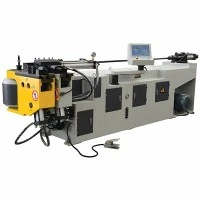
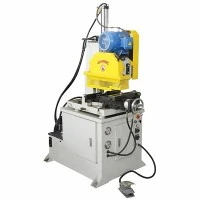

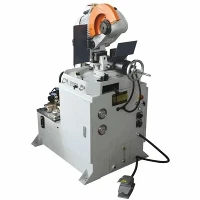


Round Tube Sawing Machine
Industrial Round Tube Sawing Machine: Technical & Engineering Procurement Guide
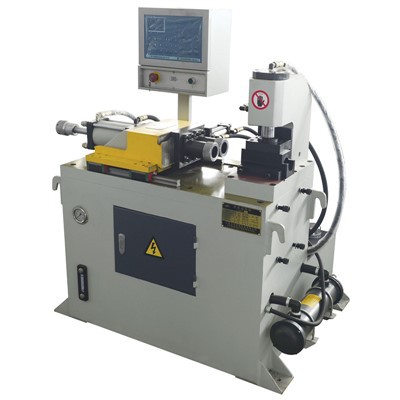
The Industrial Round Tube Sawing Machine is engineered for continuous cut-off operations on structural and mechanical tubular profiles. Built on a stress-relieved Meehanite cast-iron bed with a rigid gantry structure, this machine delivers clean, square, and burr-free cuts on carbon steel, stainless steel, alloy, and non-ferrous tubes.
Designed for standalone operation or seamless integration into automated bundle-loading production lines, it maintains strict length tolerances at high cycle rates, directly reducing secondary deburring and end-facing operations.
Technical Specifications
|
Model Series |
TS-65A (Automatic) |
TS-80NC (High-Precision) |
TS-120H (Heavy-Duty) |
|
Max. Cutting Diameter (OD) |
15 - 65 mm |
20 - 80 mm |
30 - 120 mm |
|
Max. Wall Thickness |
0.5 - 4.0 mm |
0.5 - 6.0 mm |
1.0 - 10.0 mm |
|
Standard Cutting Length |
10 - 1500 mm (Servo-driven) |
10 - 2000 mm (Servo-driven) |
20 - 3000 mm (Servo-driven) |
|
Length Tolerance |
±0.1 mm |
±0.05 mm |
±0.15 mm |
|
Spindle Motor Power |
4.0 kW (Inverter-controlled) |
5.5 kW (Servo spindle) |
7.5 kW (Heavy-duty gear drive) |
|
Blade Peripheral Speed |
20 - 120 m/min (Variable) |
15 - 100 m/min (Variable) |
10 - 80 m/min (Variable) |
|
Hydraulic System Pressure |
5.0 MPa |
5.5 MPa |
7.0 MPa |
|
Operating Voltage |
380V / 50Hz / 3Ph (Customizable) |
380V / 50Hz / 3Ph (Customizable) |
380V / 50Hz / 3Ph (Customizable) |
Key Features
Rigid Meehanite Cast Bed: Machine frames undergo annealing at 600°C followed by CNC gantry milling, restricting structural deflection under heavy cutting loads to within 0.01 mm.
Closed-Loop Servo Feeding: Material indexing utilizes a Panasonic/Mitsubishi absolute encoder servo motor coupled with a precision ball screw, eliminating cumulative pitch drift during continuous high-speed cycling.
Hydraulic Vise Clamping System: Dual-direction vertical and horizontal clamping jaws wrap around the tube O.D., preventing wall collapse or ovality distortion on thin-walled stainless steel or aluminum stock.
Targeted Micro-Mist Lubrication: Synthetic cutting fluid is delivered directly to the TCT saw blade tooth interface via compressed air circuits, lowering thermal distortion and extending insert longevity.
Real-Time PLC Diagnostics: The HMI logs spindle load currents, proportional valve pressures, and sensor feedback loops, providing immediate error codes to minimize diagnostic downtime.
Working Process
Automatic Bundle Loading: Raw round tubes load onto an inclined magazine rack; an escapement mechanism indexes and drops a single tube into the V-groove feeding rollers.
Servo Length Indexing: The feeding gripper clamps the tube rear and indexes forward to the programmed cut-off length governed by closed-loop encoder feedback.
Hydraulic Clamping & Carriage Descent: Front and rear hydraulic vices clamp the workpiece. The saw carriage feeds downward via a proportional hydraulic valve circuit, adapting feed rates to material resistance.
Retraction & Remnant Sorting: Upon cycle completion, the saw head retracts vertically, the vise jaws unclamp, and a pneumatic ejector separates the cut component from the tail-stock scrap (remnant).
Applications
Automotive Exhaust & Structural Frames: High-speed processing of aluminized and stainless steel tubes for exhaust systems, roll cages, and tubular sub-frames.
Industrial Furniture & Display Fixtures: Clean 90-degree cuts on thin carbon steel tubing requiring minimal pre-coating preparation.
HVAC & Fluid Conveyance: Burr-free cutting of copper, brass, and stainless steel lines where internal particulate contamination must be strictly prevented.
Fitness Apparatus: Heavy-wall structural round tubing processing for multi-station gym equipment and load-bearing frames.
Tooling & Configuration
Saw Blade Options:
TCT (Tungsten Carbide Tipped) Circular Saw Blades (250 - 425 mm) for high-speed carbon steel processing.
HSS (High-Speed Steel) Coated Blades (TiN / TiAlN) for thin-walled stainless steel and alloy applications.
Vise Jaw Inserts: Custom-machined sintered steel or polyurethane-lined jaw inserts matching exact tube outer diameters to eliminate surface marring.
Core Electrical & Pneumatic Components:
PLC & HMI: Siemens S7-1200 / Schneider.
Servo Drives: Yaskawa / Panasonic.
Pneumatics: SMC / Festo.
Hydraulics: Yuken / Rexroth proportional valves.
Customization
Unloading Conveyors & Sorting: Integration with automatic length sorting chutes, gravity drop tables, or robotic sorting arms for finished parts.
Inline Chamfering Units: Single or double-head end-machining modules attached to the discharge end for simultaneous inside and outside deburring.
Special Voltage & Safety Compliance: Custom electrical cabinets meeting CE, UL, or CSA control circuit standards with interlocked safety light curtains.
Quality & Testing
In-house machining and strict metrological verification govern our production workflow:
Bed Machining: Main casting frames are machined on large-scale floor-type boring and milling centers, holding parallelism tolerances within 0.02 mm per 1000 mm.
Spindle Dynamic Balancing: All saw spindles undergo high-speed dynamic balancing (G2.5 grade) to eliminate vibration chatter at operating speeds up to 4000 RPM.
Factory Burn-In Test: Every assembled machine undergoes a continuous 72-hour dry-run and live material test-cutting cycle (processing 500 consecutive pieces) prior to crating, verifying dimensional repeatability and hydraulic circuit stability.
FAQ
Q: How does the machine prevent burrs on the inner and outer edges of stainless steel tubes?
A: Burr formation is controlled through three factors: rigid hydraulic clamping that prevents tube wall vibration, synchronized downward feed control via proportional valves, and the use of specialized tooth-pitch TCT saw blades combined with micro-mist lubrication.
Q: What is the minimum remaining scrap (remnant) length per tube?
A: Standard pneumatic feeding leaves a tail-stock remnant of approximately 50 - 80 mm. Optional short-remnant feeding configurations can reduce tail scrap down to 15 - 30 mm to maximize material utilization.
Q: Can this saw handle both 90-degree straight cuts and angle cutting?
A: Standard models are fixed at 90 degrees for optimal rigidity and tolerance holding. For facilities requiring miter cuts, we offer swivel-head or rotating-vise configurations capable of angular adjustments from 90° to 45°.
Q: What is the typical blade life when cutting standard carbon steel tubing (50 x 2 mm)?
A: Under standard operating conditions with proper coolant flow and correct feed rates, a high-quality TCT saw blade yields between 3,000 to 5,000 cuts before requiring professional sharpening.
Q: How is remote troubleshooting handled if an electrical fault occurs?
A: The Siemens/Schneider PLC control system features an Ethernet port for remote diagnostic connection. Our engineering team can access the ladder logic, review alarm logs, and update parameter settings directly over secure channels.
Q: What utility requirements must be prepared on-site prior to installation?
A: Facilities require a 3-phase power supply (typically 380V, 50Hz unless customized), a compressed air line delivering a stable pressure of 0.6 - 0.8 MPa (50 L/min flow), and a soluble oil coolant mixture for the internal fluid reservoir.
Hot Tags: round tube sawing machine, China round tube sawing machine manufacturers, suppliers, factory
Previous
Square Tube Sawing MachineNext
No InformationYou Might Also Like




Send Inquiry