

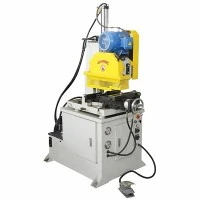

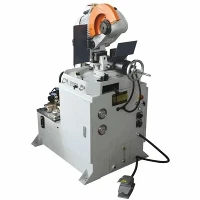


Bar Stock Sawing Machine
Heavy-Duty Industrial Bar Stock Sawing Machine
Engineered for continuous multi-shift production in demanding metalworking environments, this industrial bar stock sawing machine delivers high-precision, straight cuts across solid carbon steel, alloy steel, stainless steel, and titanium bars. Constructed around a stress-relieved Meehanite cast iron base, the heavy machine weight (3,200 kg to 8,500 kg) dampens high-frequency cutting harmonics to prevent premature tooth micro-chipping. Dual hydraulic clamping vices grip both sides of the kerf simultaneously to eliminate material shifting, while direct-port flood coolant targets the exact blade guide exit interface to control thermal expansion on large-diameter cross-sections.
Technical Specifications
|
Parameter |
Specification Range / Value |
|
Max Cutting Capacity (Round) |
300 mm – 800 mm |
|
Max Cutting Capacity (Rectangular) |
600 x 400 mm – 1000 x 600 mm |
|
Blade Dimensions |
41 x 1.3 mm to 67 x 1.6 mm |
|
Main Drive Motor |
7.5 kW – 18.5 kW (Vector-controlled Inverter) |
|
Blade Speed |
15 – 120 m/min (Stepless variable frequency) |
|
Hydraulic System Pressure |
4 – 6 MPa (Adjustable proportional valves) |
|
Feeding Stroke (Single Index) |
500 mm (Auto-indexing multi-stroke up to 2000 mm) |
|
Machine Weight |
3,200 kg – 8,500 kg |
Key Features
Rigid Twin-Column Vertical Guidance: Heavy-walled structural steel columns, precision ground and hard-chrome plated to 0.02 mm surface tolerance, maintain absolute blade squareness during deep-penetration cutting of heavy alloy billets.
Vector-Controlled Blade Drive: Planetary gearbox paired with a high-torque AC inverter drive matches blade surface speed precisely to material hardness, preventing torque drop-off during heavy-load breakthroughs.
Hydraulic Band Tensioning System: Integrated accumulator-backed hydraulic circuit applies a constant 250 N/mm² tension force to the idle wheel, absorbing thermal elongation of the blade during extended production runs.
Automated Swarf Management: Integrated scraper-type chip conveyor running beneath the cutting bed prevents swarf buildup and coolant pooling during high-feed structural steel operations.
Non-Contact Material Height Sensing: Optoelectronic sensors measure raw bar height prior to the approach stroke, eliminating air-cutting time and optimizing cycle duration.
Working Process
Loading & Indexing: Raw bar stock is fed via heavy-duty roller tables into the clamping zone; auto-indexing vises clamp the material and position it against the mechanical length stop within plus-minus 0.2 mm tolerance.
Material Clamping: Main front and rear hydraulic vices close simultaneously, securing the bar on both sides of the kerf line to prevent pinching and vibration as the cut finishes.
Approach & Sensing: The saw head lowers rapidly in fast-traverse mode until the blade rests 2 mm above the stock surface, switching automatically to the programmed cutting feed rate.
Cutting Execution: The bi-metal or carbide-tipped band penetrates the material under closed-loop hydraulic downfeed pressure control, continuously clearing chips via high-pressure coolant nozzles.
Retraction & Reset: Upon breakthrough, the blade halts, retracts vertically by 10 mm, vices release, and the next automated indexing cycle initiates.
Applications
Steel Service Centers: High-volume, multi-shift production cutting of structural steel bars, carbon rounds, and rectangular blooms for commercial distribution.
Forge Shops: Sectioning heavy alloy and tool steel billets prior to drop-hammer or hydraulic press forging operations.
Aerospace Component Manufacturing: Precision profiling of high-nickel superalloys, Inconel, and titanium bar stock with strict metallurgical integrity requirements.
Automotive Powertrain Production: High-speed blanking of transmission shafts, axle blanks, and steering knuckles from rolled steel bars.
Tooling & Configuration
Blade Selection: Compatible with bi-metal M42/M51 blades for general alloy steels and specialized multi-chip carbide-tipped band saws for high-hardness materials (> HRC 45).
Infeed and Outfeed Roller Tables: Modular dead or powered roller conveyors available in 2-meter increments, equipped with mechanical length measuring stops or digital DRO encoders.
Bundle Cutting Fixtures: Top-press vertical hydraulic clamping attachments configured for simultaneous multi-bar cutting of smaller diameter rounds or tubes.
Mist Lubrication System: Minimal Quantity Lubrication (MQL) option available for dry-chip operations, reducing coolant disposal costs and secondary cleaning steps.
Customization
Extended Feeding Stroke: Custom multi-indexing logic integrated into the PLC for automated cutting of bar lengths exceeding standard machine envelopes.
Automated Sortation Integration: Synchronization modules to link the saw discharge chute with downstream sorting bins, robotic handlers, or weighing scales.
Special Voltage Engineering: Electrical control cabinets built to comply with regional safety standards, including UL/CSA specifications and specific industrial supply voltages (480V / 60Hz or 575V).
Quality & Testing
Structural frames undergo thermal annealing at 600°C after welding to eliminate internal residual stress before precision CNC line boring. Every assembled machine undergoes a mandatory 72-hour continuous dry-run test followed by a live trial cut on a 400 mm forged 4140 steel bar. Dimensional squareness, flatness, and parallelism across the cut face are verified using laser interferometers, ensuring maximum deviation remains under 0.1 mm per 100 mm of cutting height. ISO 9001 quality management protocols govern incoming material inspection, sub-assembly testing, and final electrical safety validation.
FAQ
Q: How does the machine prevent blade drift when cutting large-diameter high-alloy steel bars?
A: Blade deviation is minimized through rigid twin-column vertical guiding, carbide guide inserts that apply lateral stabilization close to the cutting point, and closed-loop hydraulic downfeed regulation that adjusts feed rate automatically when encountering internal material inconsistencies.
Q: What is the typical kerf loss, and how does it save material costs?
A: Standard blade thickness ranges from 1.3 mm to 1.6 mm, resulting in a narrow kerf width of approximately 1.5 mm to 1.8 mm. This thin-kerf profile preserves expensive raw materials like titanium and tool steel compared to traditional cold saws or shearing methods.
Q: Can the saw integrate into an existing automated cut-to-length line?
A: Yes. The Siemens PLC control system features standard digital I/O handshaking protocols and Ethernet communication ports, allowing seamless integration with upstream material storage racks and downstream deburring or handling robotics.
Q: What maintenance is required to ensure consistent cutting accuracy over multi-shift operation?
A: Daily maintenance involves inspecting carbide blade guides for wear, clearing swarf from the chip conveyor, checking coolant concentration levels, and cleaning the optical sensors. Weekly checks focus on hydraulic fluid levels, wire brush tensioning, and drive belt inspection.
Q: What is the standard lead time for replacement wear parts like guides and tension cylinders?
A: Common wear components, including carbide pads, wire brushes, drive belts, and hydraulic seals, are stocked locally in regional distribution hubs for dispatch within 24 hours. Critical structural or electrical assemblies ship directly from factory inventory.
Q: What safety interlocks are integrated into the enclosure to protect operators?
A: Interlocked safety switches prevent blade operation when access doors are open. Hydraulic pressure relief valves prevent catastrophic clamping failure during power interruptions, and emergency stop pushbuttons are positioned at both operator panel and discharge zones.
Hot Tags: bar stock sawing machine, China bar stock sawing machine manufacturers, suppliers, factory
You Might Also Like


Send Inquiry