

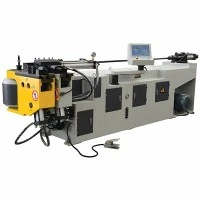

Electric Tube Bending Machine
Product Overview
The CNC Electric Tube Bending Machine utilizes multi-axis servo motor control to execute precise rotary draw, compression, or roll bending operations. Engineered for high-throughput production environments, this machine eliminates hydraulic fluid dependency, reducing thermal drift, maintenance downtime, and energy consumption by up to 40% compared to traditional hydraulic systems.
Built on a stress-relieved steel fabrication base, the architecture maintains structural rigidity during high-acceleration bending cycles. Integrated with a proprietary industrial CNC interface, it handles complex multi-radius geometries, tight CLR (Center Line Radius) applications, and springback compensation algorithms natively within the control loop.


Direct-Drive Servo Architecture:
Bending, feeding, and rotation are driven by dedicated AC servo motors coupled to precision planetary gearboxes, yielding zero backlash and high dynamic response.
Dynamic Springback Compensation:
The control system measures material elastic recovery in real-time and automatically adjusts the over-bend angle on subsequent cycles without manual operator intervention.
Quick-Change Tooling Stack:
Modular tooling design allows operators to swap collets, pressure dies, and wiper dies within 15 minutes using standard hand tools.
Collision Simulation Software:
3D offline programming software simulates the complete bending sequence, checking for machine interference, clearance issues, and axis limits before physical execution.
Programmable Mandrel Extraction:
Early mandrel retraction is controlled via programmable axis timing, preventing inner-wall wrinkling and tearing on thin-walled stainless steel or titanium tubes.
Technical Specifications
|
Technical Parameter |
Specification Value / Range |
|
Max. Tube Diameter (OD) |
Up to 89 mm (Customizable up to 120 mm) |
|
Max. Wall Thickness |
0.5 mm - 4.0 mm (Material dependent) |
|
Min. Bending Radius (CLR) |
1.0D - 1.5D |
|
Max. Bending Angle |
190 deg (Programmable over-bend for springback) |
|
Bending Axis Drive |
Absolute Encoder Servo Motor |
|
Controlled Axes |
3 to 8 Axes (Y, B, C, Feed, Carriage Shift, Mandrel Shift) |
|
Repeated Positioning Accuracy |
+/-0.05 mm / +/-0.05 deg |
|
Control System |
Industrial IPC with Touchscreen Interface |
|
Power Supply |
380V / 415V, 3-Phase, 50/60 Hz |
Working Process
Material Loading: The raw tube is loaded manually or via an automated bundle loader onto the carriage collet.
Feeding & Rotation: The carriage positions the tube longitudinally (Y-axis) and rotates it to the required spatial orientation (B-axis) for the first bend.
Clamping & Mandrel Positioning: The pressure die and clamp die secure the tube against the bend die, while the internal mandrel advances to the tangent point to support the tube inner wall.
Bending Execution: The main bend arm rotates to the programmed angle (C-axis) while the booster cylinder applies axial pressure to control wall thinning on the outer radius.
Extraction & Unclamping: The mandrel retracts prior to final angle completion, the dies open, and the carriage indexes the tube for the next consecutive bend sequence.
Applications
Automotive Exhaust & Fluid Lines:
Processes stainless steel and aluminized steel tubing for catalytic converter assemblies, turbocharger pipes, and chassis cross-members.
HVAC & Refrigeration:
Forms copper and aluminum return bends and evaporator coils with strict radius tolerances to prevent refrigerant flow restriction.

Metal Furniture & Fitness Equipment:
Handles large-radius structural carbon steel tubes for commercial frames with zero surface scratching or ovality deformation.
Aerospace Tubing:
Bends high-strength nickel alloys (Inconel) and titanium hydraulic lines meeting strict aerospace structural requirements.
Tooling & Configuration
Precision tube bending relies heavily on the correct matching of tooling components to the tube material, outer diameter, and wall thickness.
Bend Die & Clamp Die: Match the exact outer diameter of the tube with a polished groove radius to prevent surface marring.
Pressure Die: Applies longitudinal friction assist; available with integral booster blocks for tight radius (1D) applications.
Wiper Die: Positioned immediately ahead of the tangent point on tight bends to eliminate outside-radius wrinkling on thin-walled materials.
Mandrel Options: Hardened steel solid mandrels for thick tubes; multi-ball flexible link mandrels for thin-walled or tight-radius applications.
Customization
Manufacturing requirements extend beyond standard catalog parameters. Engineering modifications are available for specific integration needs:
Extended Bed Lengths:
Carriage travel extension to accommodate raw tube lengths up to 6,000 mm.
Multi-Stack Tooling:
Stack height configurations supporting up to three different radii simultaneously on a single machine head.
Automation Integration:
Robotic loading/unloading arms and pneumatic part-ejection chutes tied directly to the machine PLC via hardware safety interlocks.
Specialized Profiles:
Custom die sets engineered for square, rectangular, oval, and asymmetric extruded aluminum profiles.
Quality & Testing
Structural integrity and machining precision are verified through rigorous in-house manufacturing protocols prior to dispatch.
Bed Machining:
Machine frames are annealed to relieve welding stress, then machined on large CNC gantry milling centers in a single setup to ensure parallel guide-rail alignment within 0.02 mm.
Dimensional Inspection:
Critical components (main shafts, gearboxes, and bending arms) are verified using laser interferometers and coordinate measuring machines (CMM).
Load Testing:
Every assembled machine undergoes a 72-hour continuous dry-run test followed by actual metal bending trials using client-supplied material samples to verify angular repeatability and wall thinning limits.
Electrical Compliance:
Control cabinets are wired to strict industrial standards, utilizing CE-certified components and complete optical isolation to protect against electrical noise.
FAQ
Q: How do I prevent wall thinning and flattening on tight radius bends (1.5D)?
A: Wall thinning and flattening are mitigated by pairing the setup with an internal multi-ball mandrel, a close-fitting wiper die, and a programmable pressure die booster. The booster pushes material into the bend zone synchronously with the bend arm speed, counteracting the tensile forces that cause thinning on the outer radius.
Q: What is the advantage of an all-electric bender over a hydraulic bender?
A: All-electric benders eliminate hydraulic oil degradation, thermal expansion fluctuations, and fluid leaks. They offer higher positional repeatability (+/-0.05 deg vs. +/-0.2 deg for hydraulics), lower energy consumption during idle periods, and quicker setup changes through numerical axis positioning rather than manual mechanical limit switches.
Q: Can the control system import standard CAD files directly?
A: Yes. The industrial IPC supports the direct import of STEP or IGES files. The internal conversion software automatically extracts bend angle, rotation, and feed coordinates to generate the machine execution program, reducing manual programming errors.
Q: What data is required to get an accurate tooling and machine quotation?
A: Provide the tube outer diameter (OD), wall thickness (WT), material grade (e.g., SUS304, Al 6061, Carbon Steel), Center Line Radius (CLR), maximum straight tangents between bends, and a 2D/3D part drawing showing spatial bend coordinates.
Q: How is springback handled for high-tensile materials like titanium or high-grade stainless steel?
A: High-tensile materials exhibit significant elastic recovery. The CNC system incorporates a material database that calculates baseline springback angles. During production, the machine over-bends the material by a calculated delta and measures actual position via absolute encoders, applying iterative compensation until the target angle is locked.
Q: What kind of maintenance is required for the servo-driven axes?
A: Maintenance is significantly reduced compared to hydraulic systems. Routine procedures are limited to scheduled lubrication of linear guide rails and ball screws via an automated grease pump, periodic inspection of drive belts or gearbox backlash, and keeping the electrical cabinet air filters clean.