

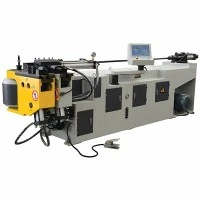

Multi-Radius Tube Bending Machine
Multi-Radius Tube Bending Machine
The multi-radius tube bending machine integrates multiple centerline radii (CLR) into a single operational sequence, eliminating the need to unload and transfer parts between separate dedicated machines. Engineered for high-complexity tubular components, the system utilizes a multi-stack tooling configuration mounted on a programmable shifting slide or vertical stack assembly.
Manufacturing facilities deploying this machine typically produce complex exhaust systems, aerospace fluid lines, and multi-bend structural frames where spatial constraints require varying radii on a continuous tube. The architecture supports CNC control across multiple axes, synchronizing feeding, rotation, and bending planes while maintaining strict positional tolerances across transitions.
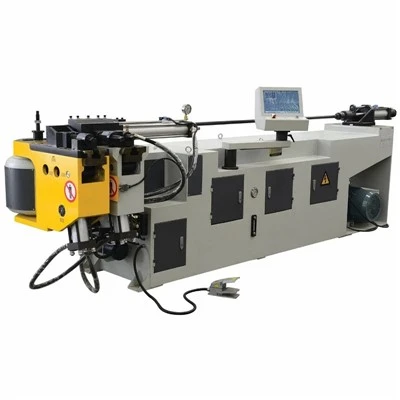


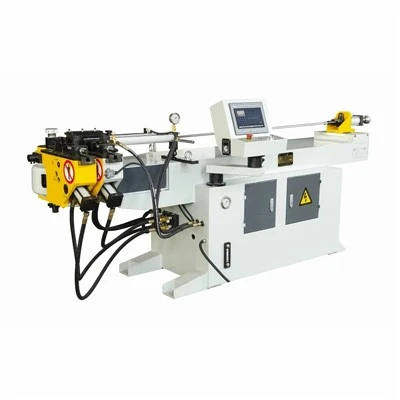

Multi-Stack Tooling Carriage:
Hydraulic or servo-driven vertical/horizontal slide positions the active tooling stack instantly, reducing cycle time between different radii transitions on a single workpiece.
Rigid Cast Iron Bed:
Stress-relieved meehanite casting dampens harmonic vibration during high-torque stainless steel and titanium processing, preventing micro-cracking at the bend extrados.
Collision Simulation Software:
Integrated 3D graphic programming interface detects tooling, clamp, and machine bed interference before physical cycle execution.
Dynamic Pressure Die Assist:
Synchronized booster cylinder applies axial push force matching the bend radius speed, neutralizing thinning on the outer radius of tight-CLR bends.
Programmable Mandrel Extraction:
Advanced advance-retract timing prevents internal wall collapse and eliminates tooling scoring on thin-walled aluminum and alloy tubing.
Technical Specifications
|
Specification Item |
Industrial Standard Range |
Heavy-Duty Configuration |
|
Max. Tube Outer Diameter (OD) |
16 mm – 50 mm |
Up to 114 mm (custom tooling dependent) |
|
Max. Wall Thickness |
0.5 mm – 3.0 mm |
Up to 6.0 mm (carbon/stainless steel) |
|
Centerline Radius (CLR) Range |
1.5D to 5D |
Configurable per stack requirement |
|
Number of Stack Levels |
2 to 3 Radii per part |
Up to 4 Stack Levels (plus push-bending) |
|
Bending Axis Precision |
+/- 0.05 deg |
+/- 0.02 deg (Closed-loop servo control) |
|
Feeding & Rotation Precision |
+/- 0.05 mm / +/- 0.05 deg |
+/- 0.02 mm / +/- 0.02 deg |
|
Drive System |
Absolute Servo Motors |
Direct-drive torque motors + hydraulic clamp |
|
Control System |
Industrial CNC / Touchscreen IPC |
Multi-axis interpolated real-time bus |
Working Process
Material Loading & Clamping: The raw tube is loaded into the collet of the carriage. The hydraulic pressure die and clamp die secure the tube against the selected radius die in the active stack.
Mandrel Positioning: The internal mandrel plug advances past the tangent point of the bend to support internal wall integrity against buckling.
Multi-Axis Bending Execution: The bending arm rotates to the programmed angle while the pressure die assists with axial thrust. For transition to a second radius, the carriage shifts vertically or horizontally to align the secondary tooling stack without releasing the main collet grip.
Retraction & Progression: The mandrel retracts slightly, the clamp and pressure dies release, and the carriage indexes the tube forward and rotates to the next plane for subsequent operations.
Part Unloading: Upon cycle completion, the finished multi-radius component clears the tooling zone automatically via pneumatic ejection or manual extraction.
Applications
Automotive Exhaust & Fluid Lines:
Catalytic converter pipes, turbocharger oil feeds, and chassis cross-members requiring tight compound bends.
Aerospace & Defense:
Environmental control system (ECS) ducting and hydraulic conduits fabricated from Inconel, titanium, and heat-resistant stainless alloys.

Commercial Furniture & Fitness Equipment:
Ergonomic structural frames integrating variable radius transitions for aesthetic and functional clearance.
HVAC & Refrigeration:
Copper and aluminum distribution headers featuring sequential tight return bends.
Tooling & Configuration
Successful multi-radius bending relies on precise tooling match. Our engineering team validates tooling geometry based on material elongation limits and springback characteristics.
Tooling Stack Components:
Mandrel balls (linkage type for tight radii), wiper die (carbide-tipped for thin-wall aluminum/steel), clamp die, pressure die, and multi-groove radius bending forms.
Material Selection:
D2 tool steel for standard carbon steel; Ampco bronze or hard-chromed alloy steel for stainless steel and titanium to prevent galling and friction pickup.
Configuration Options:
Standard 2-radius configurations up to 4-stack setups, integration with automated loading gantries, and quick-change hydraulic clamping receivers.
Quality & Testing
Production reliability is verified through strict dimensional and metallurgical testing protocols implemented across our manufacturing facility:
Frame Machining: All welded base frames undergo thermal stress relief annealing followed by CNC floor-boring machining to maintain bed parallelism within 0.03 mm over 2 meters.
Gearbox & Transmission Inspection: Planetary gearboxes and ball screws undergo laser interferometer calibration to verify backlash and positioning accuracy before final assembly.
Factory Acceptance Testing (FAT): Every machine undergoes a continuous 72-hour dry-run endurance test and a live test run utilizing customer-supplied sample tubes to verify bend angle accuracy, wall thinning ratios, and ovality limits.
Compliance Certification: Electrical panels built to CE / UL standards; hydraulic components compliant with ISO standards.
Customization
Capital machinery requires integration into existing plant layouts and manufacturing workflows. We modify standard platforms based on specific application parameters:
Specialized Carriage Lengths:
Extended bed formats to accommodate extra-long chassis tubes or industrial piping manifolds up to 6,000 mm.
Software Integration:
Custom PLC protocols (Profinet, Ethernet/IP) for interfacing with factory MES systems and robotic loading cells.
Enclosure & Safety Customization:
Perimeter light curtains, safety PLC interlocking, and acoustic dampening enclosures for high-speed automated lines.
FAQ
Q: How does a multi-radius tube bending machine differ from a single-radius machine?
A: A single-radius machine requires manual or mechanical tooling changes to switch between different bend radii on the same part, increasing cycle time and handling errors. A multi-radius machine houses multiple tooling stacks on a shifting carriage, allowing the CNC controller to switch between different radii within the same program sequence without unloading the workpiece.
Q: What is the minimum centerline radius (CLR) achievable without wall wrinkling?
A: The achievable CLR depends heavily on the tube material, outer diameter, and wall thickness ratio (T/D). Standard configurations successfully achieve 1.5D to 2D bends using a multi-ball mandrel and matched wiper die. Thin-walled stainless steel or titanium applications require specific tooling clearance analysis by our engineering team.
Q: How are tooling changeovers handled between different production batches?
A: Batch changeover time is minimized through hydraulic quick-change clamp receivers and programmed carriage indexing. Most stack-to-stack transitions within a running program occur automatically via servo positioning in under 5 seconds, while physical tooling set replacement for a completely new part family typically takes 15 to 30 minutes.
Q: What data is required to get an accurate machine and tooling quotation?
A: To ensure technical compatibility, provide your complete part drawing or 3D STEP file, tube outer diameter (OD), wall thickness, raw material grade (e.g., SUS304, Aluminum 6061), required centerline radii (CLR), and estimated annual production volume.
Q: Can this machine integrate with automated loading and unloading robots?
A: Yes. The CNC control system includes hardware I/O expansion slots and dedicated handshake protocols (such as robot safety interlocks and start/complete signals) designed for direct integration with gantry loaders, articulated robot arms, and automatic tube bundle feeders.
Q: What kind of after-sales technical support and spare parts availability do you provide?
A: We provide remote diagnostic support via secure industrial ethernet connection, complete electrical and hydraulic schematics, and comprehensive operator/maintenance training documentation. Critical wear items, including wiper dies, mandrels, and hydraulic seals, are stocked for immediate international dispatch.