

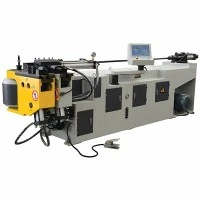
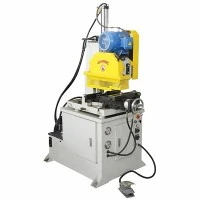

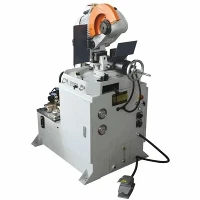


Multi-Profile Sawing Machine
The Multi-Profile Sawing Machine is engineered for high-throughput structural fabrication facilities requiring continuous, multi-geometry profile processing. Built with a rigid heavy-gauge steel welded gantry and cast iron structural bases, this machine accommodates steel channels, angles, square tubing, and custom extruded sections without requiring complex re-tooling between batches.
Operating via an integrated CNC control architecture, the system coordinates material feeding, clamping pressure, and variable-speed sawing strokes to maintain strict dimensional repeatability. Designed for integration into existing cut-to-length and fabrication lines, it minimizes manual handling and reduces material drop waste in high-volume industrial environments.
Technical Specifications
|
Parameter |
Specification |
|
Max. Profile Dimensions (W x H) |
500 mm x 400 mm |
|
Compatible Profile Types |
H-Beam, Channel Steel (UPN/UPE), Equal/Unequal Angle, Square/Rectangular Tube |
|
Main Saw Motor Power |
15 kW - 22 kW (Frequency-controlled) |
|
Blade Speed Range |
20 - 100 m/min (Stepless adjustment) |
|
Feeding Drive System |
Servo motor with rack-and-pinion transmission |
|
Length Tolerance |
+/- 0.5 mm over 3000 mm |
|
Clamping Mechanism |
Hydraulic multi-point clamping with adjustable pressure |
|
Cooling System |
Flood coolant with magnetic chip conveyor integration |
|
Control System |
Industrial PLC with 15-inch touch screen HMI |
|
Total Machine Weight |
Approx. 6,500 kg |
Key Features
Rigid Structural Frame: The main bed utilizes stress-relieved Q345B heavy structural steel plates, annealed at 650°C in a pit furnace to eliminate internal residual stress and prevent geometric warping under continuous load.
Synchronized Hydraulic Clamping: Dual-side vertical and horizontal hydraulic clamps secure variable profile geometries dynamically, preventing vibration-induced micro-fractures during the exit phase of the cut.
Precision Feed Control: Material positioning relies on closed-loop absolute encoders paired with precision planetary gearboxes, achieving positional repeatability of +/- 0.1 mm.
Adaptive Cutting Pressure: Proportional valves monitor cutting resistance in real-time, automatically adjusting feed speed when encountering varying wall thicknesses or hard spots in raw material.
Integrated Chip Management: An internal dual-auger collection trough routes metallic swarf directly to an integrated hinge-belt chip conveyor, eliminating manual clean-out downtime during multi-shift operations.
Working Process
Material Loading & Alignment: Bundled or single profiles load onto the powered input roller conveyor. Hydraulic squaring arms push the material flush against the datum reference fence.
Dynamic Clamping: The CNC unit reads the preset cut list, indexes the material via the servo gripper carriage, and engages vertical/horizontal hydraulic clamps specific to the profile geometry.
Parameter Matching: The control system selects the programmed blade speed and descent feed rate corresponding to the specific steel grade and cross-sectional area.
Sawing Cycle: The carbide-tipped or bimetal band/circular saw head descends along precision linear guide rails using a ball-screw actuator, maintaining uniform downward pressure.
Deburring & Discharge: Upon cut completion, the saw head retracts to the home position, the clamps release, and the cut piece advances to the sorting table while drop-off scrap falls into the disposal bin.
Applications
Structural Steel Fabrication: Processing structural beams, channels, and columns for commercial building frameworks and industrial plant construction.
Pre-Engineered Metal Buildings (PEB): High-speed cutting of web and flange components for welded structural portal frames.
Solar Energy Infrastructure: Cutting heavy-wall structural carbon steel profiles used in solar tracker torque tubes and ground-mount framing.
Automotive & Commercial Vehicle Manufacturing: Sizing high-strength chassis longitudinal members and cross-members prior to robotic welding.
Heavy Equipment Manufacturing: Sizing structural box sections and specialized channels for construction machinery frames.
Tooling & Configuration
Saw Blade Selection: Configurable with carbide-tipped circular blades for high-speed ferrous cutting or bi-metal band saw blades for general structural steel profiling.
Infeed/Outfeed Handling: Modular roller conveyors available in 3m increments, equipped with pneumatic pop-up measurement stops or motorized length-gauging carriages.
Marking Integration: Optional CNC inkjet or hydraulic dot-peen part-marking units mounted on the infeed table for automated serial or batch ID stamping prior to cutting.
Dust and Mist Extraction: Optional dry dust collection hoods or oil-mist filtration enclosures designed to capture particulate matter during high-speed dry-cutting operations.
Customization
Custom Profile Jaw Plates: Jaws engineered to match proprietary or non-standard extruded aluminum or alloy steel profile geometries.
Extended Cutting Capacities: Bed length and throat clearance modifications to accommodate oversized structural profiles up to 1000 mm wide.
Automation Handshaking: PLC integration protocols (Profinet, Ethernet/IP, Modbus TCP) configured to link machine output data with existing factory ERP or MES production management systems.
Voltage Adaptation: Electrical cabinets configured for regional industrial standards (380V/415V/480V, 50Hz/60Hz, 3-phase).
Quality & Testing
Manufacturing operations adhere to ISO 9001 quality management standards across structural fabrication, machining, and final assembly stages.
Weldment Integrity: All main structural frames undergo ultrasonic testing (UT) and magnetic particle inspection (MPI) on critical load-bearing weld seams to detect subsurface defects.
Precision Machining Verification: Gantry mounting surfaces and linear rail mounting pads are milled on large-scale CNC floor borers; flatness and parallelism are laser-calibrated to within 0.02 mm over a 2000 mm span.
Factory Acceptance Testing (FAT): Every machine undergoes a mandatory 72-hour continuous dry-run and loaded test cycle using standard test profiles to verify hydraulic pressure stability, thermal equilibrium of the spindle bearings, and dimensional accuracy of test cuts before crating.
FAQ
Q: Can this machine switch between cutting channels, angles, and tubes without changing physical clamp jaws?
A: The standard configuration includes quick-change universal modular vise jaws that accommodate standard angles and channels within a defined dimensional window. For specialized tube profiles or irregular extrusions, hydraulic self-centering V-jaws eliminate manual jaw swaps during standard batch transitions.
Q: How is blade life maximized when cutting high-tensile structural steels?
A: Blade life is preserved through a combination of programmable adaptive feed rates and positive coolant application. The PLC automatically reduces feed speed when the blade encounters heavier wall intersections, preventing tooth chipping, while adjustable flood nozzles maintain constant thermal suppression at the cutting interface.
Q: What is the typical installation and commissioning timeline?
A: Standard machines ship pre-assembled in modular sections. Factory technicians or certified local partners typically complete mechanical placement, electrical hookup, laser alignment, and operator training within 3 to 5 working days, depending on auxiliary conveyor integration.
Q: What file formats are compatible with the machine's CNC controller?
A: The industrial HMI accepts standard ISO G-code files and directly parses CSV or DSTV (Data Standard for Steelwork) files generated by common structural detailing software like Tekla Structures or Advance Steel.
Q: What are the power and utility requirements for site preparation?
A: The base unit requires a 3-phase 380V/415V (or customer-specified regional voltage), 50/60Hz power supply with a minimum dedicated circuit capacity of 35 kW. Compressed air supply of 0.6 - 0.8 MPa (6-8 bar) is required for pneumatic controls and clearing jets.
Q: What critical wear parts need to be stocked locally?
A: Primary consumable items include saw blades (carbide segments or bimetal bands), hydraulic return filter elements, coolant filtration media, and replaceable carbide guide pads. Comprehensive spare parts lists with OEM part numbers are provided in the machine technical manual.
Hot Tags: multi-profile sawing machine, China multi-profile sawing machine manufacturers, suppliers, factory
Previous
No InformationYou Might Also Like


Send Inquiry