

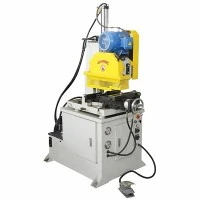

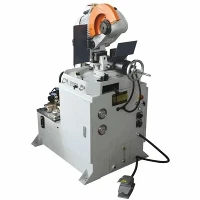
Metal Circular Saw Machine
What is Metal Circular Saw Machine?
Metal circular saw machine, also known as cold saws, use thicker and more rigid blades than band saw blades to reduce vibration and provide a better finish. Because they cut wider slots, they require more power and a more rigid machine structure. Cutting wider slots has the disadvantage of wasting more material.
Advantages of Metal Circular Saw Machine
Minimum Energy Consumption
The main purpose behind using circular saw machines is it has a longer life and faster cutting. Carbide-spiked blades are sharper and remain sharp way longer than steel substitutes because of their heat resistance and great wear.
Speed
Circular saws are much faster than other power tools, such as miter saws or jigsaws, at completing tasks. This means that using a circular saw allows you to complete your projects more quickly and efficiently.
Finest Surface Finish For The Secondary Applications
With the durability and tough structure of the blade, the edges of the blade can stay sharp for a long duration. As you know, a sharp edge is capable of making clean and smooth cutting.
Hardened Blade For Repeatable Accuracy
The primary benefit of using a circular saw blade instead of the band saw blade is its capability to have fast and repetitive accurate cuts with an excellent surface finish. These saw blades are inflexible and capable of pushing through the material efficiently.


why choose us
Our product
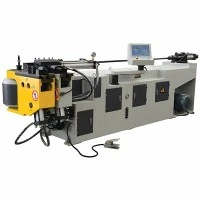
Pipe bending machine, pipe-end forming machine, cutting machine and some other pipe processing machines.
Product application
We provide unitized sets of equipments for processing pipes for automobile, physical gymnastic equipment, steel-pipe furniture, plumbing and bathing industries.
Our certificate
We have passed the authentication of iso 9001:2015 quality management system and ce certificate.
Our service
Our has set up a standardized before and after sale network and supply good and quick service to our customers.
Manual Circular Saw
Feeding, clamping, and cutting are all manual operations, mainly for some occasions where cutting requirements are not high, efficiency requirements are not high, and the cutting volume is not large.
Pneumatic Semi-automatic Circular Saw
Manual feeding, clamping & cutting are all automated operations, mainly for some occasions where efficiency is high, cutting accuracy is not high, and the cutting volume is relatively large. Suitable for smaller pipes.
Hydraulic Semi-automatic Circular Saw
Manual feeding, clamping & cutting are all automated operations, mainly for some occasions where efficiency is high, cutting accuracy is not high, and the cutting volume is relatively large. Suitable for larger pipes.
Fully Automatic Circular Saw
Feeding, clamping, and cutting are all automatic operations, and one person can operate 2-3 machines. It is mainly for some occasions with high-efficiency requirements, certain cutting accuracy requirements, and large cutting volume.
How To Choose Metal Circular Saw Machine
Choose The Model According To The Cutting Material, Shape, Size, And Thickness Of The Material, Straight Cut, Or Bevel Cut At 45 Degrees
Material: If you are cutting ferrous metals, such as iron pipes, carbon steel pipes, stainless steel pipes, galvanized pipes, etc., you can use ordinary pipe cutting machines. If you are cutting non-ferrous metals, such as aluminum and copper, you need a special aluminum cutting machine.
Shape: For different shapes, such as round tubes, square tubes, bars, or special shapes, the diameter and thickness of the processed materials are different, then the machine power required would be different.
Cutting degree: With the same circular saw, the max cutting ability for 45° cut and 90° cut is different. Because when the 45-degree cutting is performed, the cross-section of the pipe is larger, and the cutting ability naturally decreases.
Determined According To The Accuracy Requirements Or Quality Requirements Of The Cutting
Generally speaking, if you don’t have special requirements for cutting accuracy, and your volume is not very large, then for relatively small iron pipes, you can choose manual or low-power semi-automatic pipe cutting machines. But if the required cutting precision is high, the output is large, and the size of the cutting material is large or thick, then we must consider a fully automatic pipe cutting machine or at least a high-power semi-automatic hydraulic pipe cutting machine.
After The Type And Model Of The Pipe Cutting Machine Are Determined, How To Measure The Quality Of The Pipe Cutting Machine?
Stability: The stability of the metal circular saw will affect its life. Pay attention to observe whether the machine is jittery when it is working and whether there is any abnormality. Better to choose the circular saw machine constructed with thick solid steel or cast-iron. The more stable, the more durable, the more precise in cutting.
Cutting speed: When sawing metal materials, you should pay attention to the sawing speed, not too fast or too slow. The speed of the pipe cutter with good quality should be exactly the same.
Whether there is noise during cutting: Carefully listen to the sound of the pipe cutter during sawing, if the sound is harsh, be careful.
Sawing effect: The burrs after sawing should be consistent.
Saw blade: Making the right decision as to what band saw machine to purchase is important but so too is your choice of blades – a factor that sometimes is overlooked. Does the supplier provide high-quality saw blades? The price of the pipe cutter is visible, but the saw blade is a consumable part. If you have a large volume, you are destined to consume a lot of saw blades. This is a hidden cost that must be considered. A good saw blade is more durable and will help save more costs.
Coolant: Better to choose a circular saw machine with a coolant system, it will spray coolant onto the material automatically to avoid heat build-up allowing for a more accurate cut and to preserve the life of your blade.
How to Use Metal Circular Saw Machine Safely

The Installation Is Stable
Install the metal circular saw machine on a flat ground to keep the machine stable during work and reduce possible dangers. At the same time, correct installation must be carried out according to the equipment's instruction manual.
Wear Protective Equipment
When using a metal circular saw, you need to wear appropriate protective equipment, including gloves, goggles, earplugs, etc., to protect yourself and reduce injuries caused by improper operation.
Adjust The Cutting Depth
When using a metal circular saw, adjust the height of the blade according to the desired depth of cut. The saw should not protrude too much to avoid accidents.
Regular Maintenance
Metal circular saws require regular machine maintenance, including cleaning, lubrication, checking cables, etc. This ensures smooth operation of the equipment.
Observe The Condition Of The Machine
When using a metal circular saw machine, you need to observe the condition of the machine at all times. If there is any abnormality, stop the vehicle in time to check and troubleshoot. Problems may occur with any machine, and the key is to be able to detect and deal with them in time.
Storage Equipment
After using your metal circular saw, store it in a safe place where it won't be knocked or damaged. At the same time, the cutting machine needs to be placed in a dry and ventilated place to avoid rust.
Through the above precautions, we can use the metal circular saw machine more safely and make it work more efficiently.Although using a cutting machine may seem simple, it requires careful operation to ensure everyone completes the task safely and smoothly.
Large-scale Wood Cutting
In a sawmill, a circular saw is frequently used to cut big pieces of timber. Because the surface of the wood is so large, a larger circular saw is frequently used. The saw has a three-metre radius and is suitable for handling forest timbers and reducing them to a more manageable size.
Creating Firewood
A tiny circular saw is ideal for chopping firewood into compact logs. Previously, chain saws were utilized by industrial firewood makers to create logs. However, because chain saws are more prone to wear and tear, circular saws are now more commonly used.
Cutting Down Metals
Cold-saws, a type of circular saw, are commonly used to cut down metals such as bronze, brass, and steel. Metals can be precisely sliced because to the saw’s size and sharp, serrated blade.
Obtaining Straight Edges
Circular saws are often built for cutting at various angles, notably on timber, boards, and metals. A circular saw, on the other hand, will be your greatest friend when it comes to creating straight edges or 90-degree cuts if you choose a blade with additional teeth. Save the blade with fewer teeth for when the accuracy of your cut is less important.
Cross-cutting
A cross-cutting method can be used to reduce the length of lengthy wood and boards. When you cut in this manner, you are slicing the wood along the direction of the grain, which ensures that the grain quality remains excellent. A circular saw is the most convenient tool for making a cross-cut. You’ll get a better cut faster than if you used a table saw or jigsaw.
Bevel cutting
A bevel is a vertical or horizontal slope that is commonly used to connect distinct blocks. Although it won’t offer you a perfect slope, the circular saw is good for cutting bevels at a 45-degree angle. If a perfect bevel is required, consider using a table saw instead.
Cutting long plywood
Whether you’re crafting a shelf, a desk, or a spice rack, most woodworking projects will involve the usage of boards and plywood. While a table saw may be used for this, power saw specialists advocate using a circular saw.
How to Cut Metal With a Metal Circular Saw Machine
Choosing The Right Blade
Before diving into the process of cutting metal with a circular saw, it’s crucial to select the right blade. Not all circular saw blades have the same quality and specifications. Using the wrong blade can lead to inefficiency and dangerous situations.
For cutting metal, you’ll want a carbide-tipped or abrasive wheel blade specifically designed for this purpose. These blades are extremely durable and can withstand the rigors of cutting through tough metals.
Safety First
Safety should always be your top priority when working with power tools, especially when cutting metal. Here are some essential safety precautions to follow. Firstly, protective gear is paramount. Wear safety glasses or a face shield to shield your eyes from sparks and debris. A pair of earmuffs or earplugs can help protect your hearing, as metal cutting can be quite loud.
Additionally, wear gloves and a long-sleeved shirt to protect your hands and arms from hot metal chips. A respirator is also helpful depending on the type of metal you’re cutting. Ensure that your workpiece is securely clamped down to prevent it from moving while you cut, and always stand to the side of the circular saw to avoid any potential kickback.
Setting Up Your Circular Saw
Now that you’ve selected the appropriate blade and taken safety precautions, it’s time to set up your circular saw for metal cutting. Begin by adjusting the blade’s depth, ensuring that it is set just slightly deeper than the thickness of the metal you’re cutting. This minimizes the risk of sparks and blade damage.
Circular saws often have variable speed settings. A lower speed is generally better for cutting metal to prevent overheating and to maintain blade longevity. Consult your saw’s manual for rpm adjustment instructions.
Cutting Techniques
Cutting metal with a circular saw requires a different approach than cutting wood. Here are some techniques to keep in mind. First and foremost, move the saw through the metal at a slow, steady pace. Rushing can cause overheating, blade damage, and imprecise cuts. Always let the blade do the work for you.
For thicker or tougher metals, consider using cutting fluid or lubricant to reduce friction and heat buildup. This will help extend the life of your blade. When working on a big project, take regular breaks to allow the saw and blade to cool down. If you need precise, straight cuts, consider using a guide rail to maintain a straight cutting line.
FAQ
Q: Can I use a regular saw blade to cut metal with a circular saw?
Q: How can I prevent the metal from overheating during cutting?
Q: Can I use a circular saw to cut different types of metal?
Q: What is a metal circular saw?
Q: What is the difference between metal and wood cutting circular saws?
Q: What is the difference between a wood blade and a metal blade circular saw?
Q: Can a normal circular saw cut metal?
Q: What type of circular saw blade is best?
Q: What circular saw blade is best for cutting plywood and why?
Q: Can I use any circular saw blade?
Q: Can I put a metal cutting blade on my circular saw?
Q: Can a circular saw cut concrete?
Q: What is the most useful circular saw size?
Q: Is a bigger circular saw better?
Q: How thick can a circular saw cut?
Q: Can you cut plywood straight with circular saw?
Q: What are the four types of saw blades used with circular saws?
Q: Can I cut metal with my circular saw?
Q: What is the difference between metal and wood cutting circular saws?
Q: How to tell if a saw blade is for metal?