

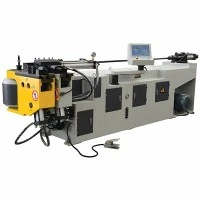
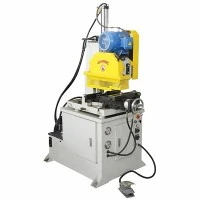

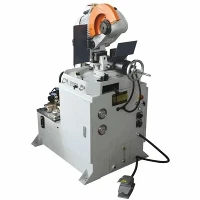
Tube & Profile Sawing Machine
High-Speed Tube & Profile Sawing Machine
Heavy-duty automatic flying saw and cold sawing systems engineered for continuous online tube mills and standalone profile processing lines. Built for high-speed, burr-free length cutting of carbon steel, stainless steel, and alloy tubes and structural profiles. Integrates CNC motion control to synchronize carriage speed with incoming material velocity, ensuring exact cut-to-length tolerances without line stoppage.


Signal Triggering:
Encoder measures incoming material length from the mill line and sends a pulse to the PLC.
Speed Synchronization:
The saw carriage accelerates to match the exact linear speed of the moving tube.
Retraction & Reset:
The blade retracts, jaws release, and the carriage returns to its home position for the next cycle.
Cut Execution:
TCT circular blade cuts through the profile wall at optimized peripheral speeds.
Clamping & Feeding:
Hydraulic jaws clamp the workpiece while the saw head feeds inward at a controlled vertical or orbital feed rate.
Technical Specifications
|
Parameter |
Specification Range |
|
Material Shape |
Round, Square, Rectangular, Open Profiles |
|
Outer Diameter (OD) |
Ф16 mm - Ф219 mm (Customizable up to Ф508 mm) |
|
Wall Thickness |
0.8 mm - 12.7 mm |
|
Cutting Speed |
Up to 120 m/min (Flying Saw Mode) |
|
Length Tolerance |
±0.5 mm (Standard), ±0.2 mm (High-Precision Servo) |
|
Drive System |
AC Servo Motor + Planetary Gearbox |
|
Saw Blade Diameter |
Ф250 mm - Ф650 mm |
|
Control System |
Siemens / Beckhoff CNC + HMI Touch Panel |
Key Features
Synchronous Tracking Carriage:
Driven by high-dynamic servo motors, the carriage matches line speed within milliseconds, eliminating mechanical shock during the cut.
Rigid Clamping Mechanism:
Interchangeable hydraulic or pneumatic jaws secure the tube contour precisely, preventing wall collapse or cross-sectional distortion during high-load sawing.
Optimized Chip Evacuation:
Integrated chip conveyors and pneumatic blast clearing prevent scrap accumulation in the cutting zone, protecting saw blades from premature tooth chipping.
Automatic Blade Lubrication:
Programmable mist-cooling oil delivery reduces friction heat, extending solid carbide TCT or HSS saw blade operational lifespan by up to 35%.
Applications
The company conducted a competitive advantage analysis to identify its strengths and weaknesses compared to its rivals.
Structural Steel Tubes & Profiles:
Scaffolding pipes, furniture tubing, and construction framing.
Automotive Components:
Chassis structural tubes, exhaust systems, and impact beam profiles.
Industrial Fluid Piping:
Low-pressure water, gas, and structural fluid transport lines.
New Energy Infrastructure:
Solar photovoltaic (PV) mounting brackets and specialized strut profiles.
Tooling & Configuration
[Main Drive Motor] ---> [ZF Two-Speed Gearbox] ---> [Precision Spindle] ---> [TCT Saw Blade]
---> [Mist Cooling System]
Core Components:
Main drive motors sourced from Siemens / ABB.
Linear guideways and ball screws from THK / Rexroth.
Pneumatic elements from SMC / Festo.
Tooling Options:
Tungsten Carbide Tipton (TCT) blades for high-speed steel cutting.
Custom profile-matched jaw inserts (cast iron or polyurethane-lined) to prevent surface scratching on exposed stainless or galvanized surfaces.

Customization
Mill Integration:
Mechanical interface design tailored to existing tube mills (Thermatool, OTO, or local lines).
Discharge Systems:
Integration with automatic deburring machines, drop tables, or bundle stackers.
Heavy-Wall Configuration:
Upgraded spindle power and hydraulic clamping circuits for pipe walls exceeding 10 mm.

In-House Machining Capabilities: Main saw bodies, carriage frames, and gearbox housings are processed on 5-axis CNC floor boring and milling centers to ensure parallel alignment within 0.02 mm.
Rigorous Factory Testing: Every sawing machine undergoes a 72-hour continuous dry-run test followed by actual metal-cutting trials under simulated line speeds prior to crating.
Inspection Protocols: Dimensional accuracy, weld seam tracking response, and electrical safety insulation resistance are verified and documented in the delivery report.
FAQ
Q: How does the flying saw prevent tube end deformation during high-speed cutting?
A: Deformation is prevented through two design elements: multi-point contour-matched clamping jaws that distribute gripping pressure evenly across the outer perimeter, and programmable servo-controlled feed rates that minimize downward thrust force on thin-walled sections.
Q: What is the typical changeover time for switching between different tube dimensions?
A: Changing jaw inserts and adjusting guide rollers takes between 15 to 30 minutes using quick-release mechanisms. Recipe storage in the HMI allows instant recall of previous cutting parameters for repeat jobs.
Q: Can this machine handle both carbon steel and stainless steel profiles?
A: Yes. Cutting stainless steel requires adjusting the spindle RPM down via the gearbox, increasing coolant flow to prevent work-hardening, and using specialized PVD-coated TCT saw blades.
Q: How do you ensure cutting length precision at line speeds exceeding 100 m/min?
A: Precision is maintained by combining a high-resolution rotary encoder measuring physical displacement with a high-speed PLC control loop that compensates for mechanical latency during servo acceleration.
Q: What are the primary maintenance requirements to maximize saw blade life?
A: Daily tasks include clearing metal chips from the clamping area and checking coolant levels. Weekly checks involve inspecting the blade tooth condition, monitoring gearbox oil temperature, and lubricating linear guide rails.
Q: What utility connections are required at the installation site?
A: The system requires a 3-phase industrial power supply (typically 380V/415V, 50Hz/60Hz), a compressed air supply at 0.6 - 0.8 MPa for pneumatic clamping and blow-off, and a dedicated workspace for coolant filtration.