

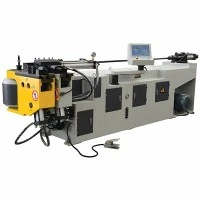
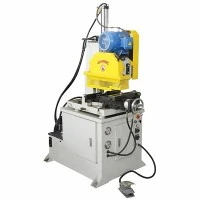

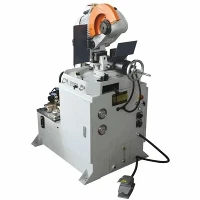

Metal Profile Sawing Machine
Industrial Metal Profile Sawing Machine | High-Precision Cold Sawing System
The industrial Metal Profile Sawing Machine executes high-speed, burr-free dry cutting for structural steel, carbon steel, stainless steel, and aluminum extrusions. Built around an annealed Meehanite cast iron base and driven by a closed-loop servo feeding system, this machine eliminates thermal distortion and secondary edge finishing.
Unlike abrasive chop saws or friction saws, cold sawing technology transfers cutting heat directly into the discarded chip rather than the workpiece. Integrated multi-axis CNC controls allow automated bundle cutting, automatic loading, and precise length sorting, matching the operational demands of high-throughput structural steel service centers and automotive component lines.
Technical Specifications
|
Model Series |
SPS-350NC |
SPS-460NC |
SPS-600CNC |
|
Max. Round Tube Capacity |
Phi 120 mm |
Phi 160 mm |
Phi 220 mm |
|
Max. Square Tube Capacity |
100 x 100 mm |
140 x 140 mm |
200 x 200 mm |
|
Max. Rectangle Capacity |
150 x 80 mm |
200 x 100 mm |
300 x 150 mm |
|
Saw Blade Diameter |
350 - 400 mm |
460 - 500 mm |
600 - 650 mm |
|
Spindle Motor Power |
7.5 kW |
11 kW |
18.5 kW |
|
Blade Speed Range |
20 - 120 RPM (Inverter) |
15 - 90 RPM (Inverter) |
10 - 60 RPM (Inverter) |
|
Feeding Servo Power |
2.0 kW |
3.0 kW |
4.5 kW |
|
Length Tolerance |
+/- 0.10 mm |
+/- 0.12 mm |
+/- 0.15 mm |
|
Machine Weight |
2,400 kg |
3,800 kg |
6,200 kg |
Key Features
Rigid Meehanite Cast Iron Bed: Absorbs high-frequency harmonic vibration during interrupted cuts on heavy-walled profiles, extending TCT (Tungsten Carbide Tipped) saw blade service life by up to 35%.
Hydraulic V-Type Clamping System: Applies simultaneous vertical and horizontal clamping pressure, locking irregular profiles and multi-channel beams in place to prevent material slippage or wall deformation.
Programmable Servo Feed Control: Automatically adjusts downfeed pressure according to real-time motor load feedback, preventing tooth chipping when transitioning through varying wall thicknesses.
Minimal Quantity Lubrication (MQL): Delivers precise micro-droplets of synthetic fatty alcohol lubricant directly to the saw kerf, maintaining blade tip temperatures below 60 degrees Celsius without contaminating downstream welding processes.
Automated Chip Evacuation: Features an integrated internal auger screw and high-torque chip conveyor that continuously ejects swarf from the cutting zone, preventing chip jamming during high-volume shifts.
Working Process
[Material Loading] -> [Bundle/Single V-Clamping] -> [Auto-Sensing Kerf Approach] -> [MQL Activation & Servo Feed Cut] -> [Retraction & Sorting]
Material Loading: Raw profiles are staged on the motorized magazine loader and indexed into the infeed roller table.
Clamping & Registration: Hydraulic V-clamps secure the workpiece against the datum fence. Optical sensors verify zero-gap seating before cycle initiation.
Controlled Approach: The saw head descends in rapid traverse mode before switching to programmed feed rate precisely 1 mm above the material surface.
Precision Cutting: The TCT circular blade rotates at material-optimized RPM while the servo ball-screw feed drives the head through the profile cross-section.
Retraction & Drop-out: Upon completion, the head retracts instantly. The sorting trapdoor opens, dropping cut parts onto the outfeed conveyor while remnant ends are segregated into scrap bins.
Applications
Structural Steel Fabrication: Processing H-beams, I-beams, channel steel, and angle iron for architectural framing and heavy industrial plant construction.
Automotive Chassis Manufacturing: Sizing high-strength low-alloy (HSLA) steel tubes for subframes, roll cages, and suspension components with strict squareness tolerances.
Solar Energy Infrastructure: Cutting heavy-walled galvanized steel torque tubes and C-purlins for utility-scale solar tracker assembly lines.
Fluid Power & Hydraulics: Precision cutting of seamless carbon steel hydraulic pipes, eliminating internal burrs that cause pump cavitation and valve contamination.
Tooling & Configuration
Selecting the correct saw blade geometry and tooth pitch dictates cut quality and cost per cut.
TCT Saw Blade Selection:
Thin-Wall Tubing (t < 3 mm): High tooth count (80 to 120 teeth), shallow tooth gullet, 5-degree negative rake angle to prevent grabbing.
Solid Bars & Heavy Profiles (t > 10 mm): Low tooth count (40 to 60 teeth), deep gullet design for efficient chip evacuation, 0-degree to positive rake angle.
Standard Factory Configuration:
Siemens PLC and 10-inch color touch-screen HMI.
Schneider electric low-voltage components.
Rexroth hydraulic valves and pump station.
NSK precision spindle bearings and ground ball screws.
Optional Modules:
Dynamic laser cutting-line projector for manual layout verification.
Automatic sorting and batch-bundling outfeed robotic arms.
Fume extraction hood with electrostatic oil mist collector.
Customization
Manufacturing operations require machine footprints and handling aids tailored to existing shop floor layouts. Engineering modifications include:
Custom Jaw Profiles: CNC-machined split jaws matching complex extruded aluminum profiles or irregular casting geometries to eliminate surface marring.
Infeed/Outfeed Extensions: Extended roller tables and cross-transfer chains scaled for 12-meter structural steel lengths.
Multi-Axis Integration: Seamless handshake protocols with downstream robotic welding cells or automated stamping presses via Profinet/Modbus TCP.
Voltage Adaptation: Electrical power configurations built to order for 380V/50Hz, 440V/60Hz, or 480V/60Hz 3-phase industrial grids.
Quality & Testing
Internal production facilities maintain strict dimensional and structural control before shipment:
Structural Machining: Main bed castings are stress-relieved via thermal annealing, followed by finish-milling on five-axis CNC gantry milling centers to maintain bed flatness within 0.03 mm per 1000 mm.
Spindle Runout Verification: Dial indicator testing confirms dynamic radial runout of the main saw spindle remains under 0.008 mm.
Continuous Load Testing: Every machine undergoes a mandatory 8-hour dry-run endurance test combined with a 2-hour actual cutting test on 45# carbon steel solid bars.
Inspection Protocol: Final factory sign-off requires a coordinate measuring machine (CMM) verification report for squareness, parallelism, and length repeatability.
FAQ
Q: How does a metal profile sawing machine prevent burrs compared to band saws or abrasive chop saws?
A: Cold sawing utilizes rigid tungsten carbide-tipped (TCT) circular blades operating at low RPM combined with heavy hydraulic clamping. The blade shears the metal cleanly rather than tearing or melting it, producing a ready-to-weld, burr-free edge that eliminates secondary grinding.
Q: What is the maximum wall thickness this machine can handle on structural steel tubes?
A: Capacity varies by model. For instance, the SPS-460NC handles square tubes up to 140 x 140 mm with a maximum recommended wall thickness of 16 mm in structural carbon steel. Consult engineering for high-tensile alloy applications.
Q: Can this machine process bundles of tubes simultaneously?
A: Yes. When equipped with the optional vertical bundle-clamping attachment and multi-layer spacer plates, the machine locks multiple tubes securely to maintain high output volume without shifting or internal vibration.
Q: How do you calculate the consumable cost per cut for TCT blades?
A: Cost per cut depends on material hardness, cross-sectional area, blade tooth count, and cutting speed. TCT blades can typically be re-sharpened 4 to 6 times using specialized CNC sharpening equipment, lowering overall consumable expenses per thousand cuts.
Q: What power supply and pneumatic lines are required for factory installation?
A: Standard units require a 380V/480V 3-phase electrical supply (ranging from 11 kW to 22 kW total connected load depending on model size) and a compressed air line delivering 0.6 to 0.8 MPa clean, dry air for pneumatic indexing and lubrication atomization.
Q: What is the standard delivery lead time and warranty coverage?
A: Standard machine configurations ship within 30 to 45 days. Custom-engineered handling systems or non-standard voltage setups require 60 to 75 days. All primary mechanical and electrical components include a 12-month replacement warranty backed by remote diagnostic support.
Hot Tags: metal profile sawing machine, China metal profile sawing machine manufacturers, suppliers, factory
You Might Also Like


Send Inquiry