

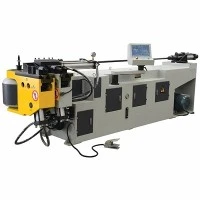



CNC Mandrel Tube Bending Machine
The CNC Mandrel Tube Bending Machine utilizes multi-axis servo control to produce precise, repeatable bends in thin-walled metal tubes and pipes without flattening, wrinkling, or excessive cross-sectional distortion. Designed for high-production manufacturing environments, the machine synchronizes programmable logic controllers (PLC) with precision ball screws and hydraulic clamping systems to maintain consistent centerline radii (CLR) down to 1xD.
Integrated production infrastructure-including in-house CNC gantry milling for structural bed leveling and strict laser interferometer alignment checks-ensures frame rigidity and long-term geometric stability under continuous industrial operation.
Technical Specifications
|
Parameter / Specification |
Standard Industrial Range |
|
Max. Tube Outer Diameter (OD) |
16 mm – 168 mm (Customizable up to 219 mm) |
|
Max. Wall Thickness |
0.5 mm – 10 mm (Material dependent) |
|
Min. Centerline Radius (CLR) |
1xD – 1.5xD (Using standard mandrel and wiper die) |
|
Bending Axis Speed |
Up to 40° / second (Programmable servo-driven) |
|
Bending Accuracy (Repeatability) |
± 0.05° |
|
Feed & Rotation Accuracy |
± 0.05 mm / ± 0.05° |
|
Axis Configuration |
3-Axis to 9-Axis (YBC / YBC-P combinations) |
|
Control System |
Industrial CNC with Touchscreen Interface (EtherCAT bus) |
|
Max. Mandrel Extinction Distance |
Programmable early mandrel extraction (0 to 50 mm) |
Key Features
Multi-Axis Servo Synchronization: Independent AC servomotors drive the feed (Y), rotation (B), and bend (C) axes, eliminating mechanical backlash and maintaining tight synchronization during complex compound bends.
Programmable Early Mandrel Extraction: The hydraulic mandrel extraction unit retracts the plug before the bend cycle completes, preventing inside-diameter scoring and reducing friction on thin-walled stainless steel or titanium tubing.
Rigid Cast-Steel/Welded Frame Assembly: Heavy-wall structural steel tubing and stress-relieved weldments absorb high torsional loads during high-pressure bending cycles, minimizing frame springback.
Multi-Stack Tooling Stackers: Accommodates up to three different radii or multi-radius tooling stacks on a single machine head, enabling complex component fabrication without manual tool changes.
Graphical 3D CNC Control Interface: Operators import standard STEP or IGES CAD files directly into the industrial controller, which automatically calculates springback compensation and generates machine execution code.
Working Process
Material Loading: The operator or automated loader positions the raw metal tube onto the carriage collet.
Mandrel Positioning: The internal mandrel advances inside the tube to the exact tangent point of the upcoming bend to support the inner wall.
Clamping & Pressure Die Setup: The clamp die secures the tube against the bend die, while the pressure die applies longitudinal assist force to push material into the bend zone, mitigating outer-wall thinning.
Bending Execution: The bend arm rotates to the programmed angle (C-axis) while the pressure die and carriage move in coordinated harmony.
Mandrel Extraction & Unclamping: The mandrel retracts slightly prior to completion, the clamp and pressure dies release, and the carriage indexes (Y/B axis) for the next bend or unloads the finished part.
Applications
Automotive Exhaust & Chassis: Fabricating complex catalytic converter inlet pipes, roll cages, and structural subframes from aluminized steel and stainless steel tubing.
Aerospace Fluid Lines: Bending high-purity, thin-walled Inconel, titanium, and aluminum alloy tubes for aircraft environmental control and hydraulic systems.
HVAC & Refrigeration: Producing U-bends and complex return headers in copper and aluminum heat exchanger tubing without flow restriction.
Heavy Machinery & Hydraulics: Constructing high-pressure hydraulic fluid distribution lines that withstand operating pressures exceeding 300 bar without joint fatigue.
Tooling & Configuration
Tooling Components: Proper bend execution relies on a matched set consisting of the bend die, clamp die, pressure die, wiper die, and mandrel (plug, formed, or ball/link mandrel for tight radii).
Material Selection: Tooling is manufactured from high-alloy tool steel (e.g., H13, D2) or Ampco bronze / aluminum bronze to prevent galling when forming stainless steel, carbon steel, or non-ferrous tubes.
Configuration Options:
Standard YBC Configuration: Basic 3-axis setup for planar bends.
Full-Auto CNC Multi-Stack: Recommended for aerospace and automotive parts requiring multiple radii and complex spatial routing in a single clamping operation.
Booster Assist: Integrated hydraulic push booster on the pressure die slide for ultra-tight radii (1D) on thin-walled applications.
Customization
Specialized Bending Heads: Extended or narrow profile bend arms designed to clear complex, multi-bend geometries where traditional tooling interferes with previously formed bends.
Automation Integration: Interface readiness for robotic loading/unloading arms, automatic bundle loaders, and downstream laser cutting or end-forming stations.
Voltage and Power Specifications: Electrical configurations built to match regional plant standards (e.g., 380V/50Hz, 415V/50Hz, 480V/60Hz 3-phase).
Seam Detection Sensors: Optical or mechanical weld-seam finders integrated into the collet rotation axis to orient the tube seam toward the neutral axis during bending.
Quality & Testing
Structural Machining: Main machine beds and bending heads are machined on large CNC floor-type boring and milling centers in a single setup to guarantee parallelism and perpendicularity across all mounting faces.
Dimensional Inspection: Frame weldments undergo ultrasonic testing (UT) and magnetic particle inspection (MPI) on critical load-bearing seams. Post-machining verification utilizes laser trackers to confirm axis alignment within 0.02 mm.
Factory Acceptance Testing (FAT): Every machine undergoes a continuous 72-hour dry-cycle test followed by live material sample bending using the customer's specific tube grade and dimensions. Measured part dimensions (radius, wall thinning percentage, and ovality) are documented in an inspection report shipped with the equipment.
Compliance Certification: Electrical cabinets adhere to CE and UL panel construction standards, utilizing industrial components from Schneider, Siemens, and Mitsubishi.
FAQ
Q: What prevents tube wall thinning and wrinkling during tight-radius bends?
A: Wall thinning and wrinkling are controlled through a combination of tooling geometry and mechanical force application. A multi-ball mandrel supports the inner diameter directly at the tangent point to prevent inward collapse. Simultaneously, a wiper die positioned immediately ahead of the bend point prevents outer-wall ripples, while a hydraulic pressure die booster pushes material forward into the bend zone to maintain uniform wall thickness.
Q: What is the maximum wall thickness and OD the machine can handle?
A: Standard configurations process tube outer diameters from 16 mm up to 168 mm, with wall thicknesses ranging up to 10 mm depending on the material's tensile strength. Heavy-wall structural pipes or specialized high-tensile alloys (such as titanium or high-nickel stainless steels) require specific clamping tonnages and motor torque ratings, which are configured during the engineering review stage.
Q: Can the CNC controller import CAD files directly?
A: Yes. The industrial CNC control unit accepts standard 3D CAD file formats including STEP, IGES, and DXF. The software automatically extracts bend data (XYZ coordinates or YBC values), simulates the bending sequence to check for physical machine collisions, and compensates for material springback based on stored elasticity profiles.
Q: What data is required to get an accurate tooling and machine quotation?
A: To select the correct machine model and design appropriate tooling, submit the following parameters: tube outer diameter (OD), wall thickness, material grade (e.g., 304 stainless steel, 1020 carbon steel, aluminum 6061), centerline radius (CLR), degree of bend (DOB), straight tangents between bends, and expected annual production volume.
Q: How is machine installation and operator training handled?
A: Standard delivery includes remote commissioning assistance and comprehensive digital operation manuals. For on-site requirements, factory-certified service engineers are dispatched to handle mechanical leveling, laser axis calibration, trial production runs, and hands-on training for your maintenance and programming personnel.
Hot Tags: cnc mandrel tube bending machine, China cnc mandrel tube bending machine manufacturers, suppliers, factory, Automatic Multi Stack Pipe Bending Machine, Automatic Small Diameter Pipe Bending Machine, CNC Precision Tube Sawing Machine, CNC Programmable Tube Bender, Hydraulic Stainless Steel Tube Bending Machine, Servo Metal Tube Bending Machine
Previous
Hydraulic Mandrel Tube BenderNext
No InformationYou Might Also Like


Send Inquiry