

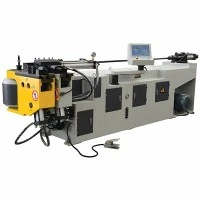



Servo Electric Tube Bending Machine
Servo Electric Tube Bending Machine
The CNC Servo Electric Tube Bending Machine utilizes multi-axis absolute servo motor drives (Siemens Sinumerik CNC architecture) to execute high-precision, programmable cold bending operations for metal tubes and profiles. Operating without hydraulic oil systems, this architecture eliminates thermal drift, reduces energy consumption by up to 45%, and achieves angular repeatability of +/-0.05 deg. Built with a rigid Meehanite cast iron frame and finite element analysis (FEA) optimized stress distribution, the machine handles complex multi-radius geometries across stainless steel, carbon steel, copper, and aluminum alloys for tier-1 manufacturing environments. Built under ISO 9001:2015 quality management standards and fully compliant with CE safety directives.
Technical Specifications
|
Technical Parameter |
Standard Specification (Model: SEB-50-CNC) |
|
Max. Tube Diameter |
50 mm x 3.0 mm (Mild Steel, sigma_b <= 400 MPa) |
|
Max. Bending Radius (CLR) |
200 mm (Tooling dependent) |
|
Min. Bending Radius |
1.5 x OD (Mandrel dependent) |
|
Max. Bending Angle |
190 deg (Programmable over-bend for springback) |
|
Bending Axis Precision |
+/-0.05 deg (Direct-drive servo gear-box coupling) |
|
Feeding Axis Precision |
+/-0.05 mm (Rack and pinion / ball screw drive) |
|
Rotation Axis Precision |
+/-0.05 deg (High-torque indexer servo) |
|
Controlled Axes |
5-Axis (Y: Feeding, B: Rotation, C: Bending, X: Horizontal Shift, Z: Vertical Shift) |
|
Control System |
Siemens Sinumerik 840D sl Industrial CNC (EtherCAT bus architecture) |
|
Power Supply / Total Load |
380V / 50Hz / 3-Phase, 22 kW |
|
Machine Weight |
4,200 kg |
Key Features
Direct-Drive Servo Architecture: Replaces proportional hydraulic valves with absolute multi-turn servo motors on the bending, feeding, and rotation axes, eliminating oil leakage, filter maintenance, and hydraulic oil cooling loops.
Closed-Loop Springback Compensation: Integrated angular sensors measure material elastic recovery in real-time, automatically adjusting the over-bend angle on the subsequent cycle to maintain dimensional tolerance on high-tensile stainless steel.
Interference Collision Detection: 3D simulation software embedded in the Siemens CNC controller runs offline path validation prior to execution, preventing physical collision between the tube, pressure die, and machine frame during complex multi-stack bends.
Multi-Stack Tooling Stack-Up: Accommodates up to three different radius tool sets simultaneously on a single arbor, allowing complex component production without manual die changeovers.
Rigid Stress-Relieved Bed: The main machine base undergoes annealing at 650 deg C followed by CNC gantry milling in a single clamping setup, ensuring geometric stability under continuous high-torque operations.
Working Process
Material Loading: The raw tubular stock is manually or automatically loaded into the pneumatic collet chuck on the feeding carriage.
Axis Positioning (Y/B/X/Z): The Siemens CNC system coordinates the longitudinal feed (Y), rotational orientation (B), and tooling shift (X/Z) to position the tube precisely against the pressure die and mandrel tip.
Mandrel & Pressure Die Advancement: Internal mandrel balls advance inside the tube to support the inner wall radius, while the wiper die and pressure die lock the material to prevent flattening or wrinkling.
Servo Bending Execution (C-Axis): The main servo motor drives the bend arm around the radius die to the programmed angle, with dynamic pressure-die boosting maintaining constant tension.
Retraction & Unloading: The mandrel retracts slightly, the pressure die opens, and the finished bent component indexes out for inspection or secondary handling.
Applications
Automotive Exhaust & Fluid Lines: Forming complex 3D routing for catalytic converter inlet pipes, turbocharger coolant lines, and chassis structural reinforcements in 304/409 stainless steel.
HVAC/R Distribution Coils: Producing return bends and serpentine evaporator coils in thin-walled copper and aluminum tubing without wall thinning or section collapse.
Aerospace Hydraulic Subsystems: Fabricating tight-radius fuel and hydraulic lines from Inconel and titanium alloys where wall integrity and strict non-destructive testing compliance are mandatory.
Industrial Furniture & Equipment: Bending structural frames, cart chassis, and fitness equipment tubing from ERW carbon steel with zero surface scratch marks.
Tooling & Configuration
Precision tube bending relies directly on the interface between the machine mechanics and the tooling set. Standard configurations include:
Bending Die (Form Die): Matches the exact outer diameter and centerline radius of the tube profile.
Clamp Die: Secures the tube against the bending die during the rotation cycle.
Pressure Die: Follows the tube during the bend to prevent stretching and wall thinning on the outer radius.
Wiper Die: Positioned immediately ahead of the tangent point to prevent wrinkling on tight centerline radii.
Mandrel (Plug/Flexible Link): Inserted internally to support the tube cross-section through the bend zone. Standard tool material options include hardened tool steel (Cr12MoV), aluminum bronze, and Ampco metal depending on workpiece abrasiveness.
Customization
Manufacturing operations require integration flexibility. Custom engineering modifications include:
Extended Bed Lengths: Customizable feeding carriage travel from 3,000 mm up to 6,000 mm for extra-long tubular frames.
Automation Integration: Interface compatibility with 6-axis articulated loading robots, automatic bundle loaders, and downstream laser cutting or punching cells via EtherCAT / PROFINET protocols.
Special Section Tooling: Custom die geometries engineered for square, rectangular, oval, and asymmetric extrusion profiles.
Multi-Radius Stack Configurations: Custom vertical slide configurations to house up to four distinct tooling stacks
Quality & Testing
Production adherence relies on strict in-house fabrication standards under our ISO 9001:2015 quality management system:
Structural Annealing: All weldments and heavy frame components undergo thermal stress relief annealing prior to precision machining to prevent long-term structural warp.
Laser Interferometer Calibration: Axis positioning and straightness of the feeding carriage are verified using laser interferometry to ensure linear tolerances within +/-0.02 mm.
Full-Load Factory Run-Off: Every machine undergoes a minimum 72-hour continuous dry-run test followed by sample bending trials using customer-supplied raw material specifications prior to crating.
Traceability Documentation: Each delivery includes material mill test certificates, electrical schematics, axis calibration reports, and CE safety compliance documentation.
FAQ
Q: How does a servo electric tube bender compare to a traditional hydraulic bender in terms of energy efficiency and maintenance?
A: Servo electric machines consume power only during active motion, reducing idle energy waste by 40% to 50% compared to hydraulic pumps running continuously. Maintenance overhead is significantly lower because there are no hydraulic oil changes, filter replacements, seal wear-outs, or thermal oil-leakage risks on the shop floor.
Q: What is the method for controlling tube wall thinning and wrinkling on tight-radius bends?
A: Wall thinning on the outer radius and wrinkling on the inner radius are controlled by combining a multi-ball flexible mandrel, an adjustable wiper die positioned close to the tangent point, and programmable pressure-die boost pressure that pushes material into the bend zone rather than stretching it.
Q: Can the Siemens CNC controller import external CAD/CAM file formats directly?
A: Yes. The Siemens Sinumerik industrial CNC system accepts standard CAD data formats including IGES and STEP files. The onboard programming software automatically translates 3D center-line coordinates (XYZ or YBC data) into executable machine axes movements with automatic springback calculation.
Q: What material grades can be processed without requiring secondary tooling modifications?
A: The machine processes standard structural carbon steels, 300/400 series stainless steels, aluminum alloys (e.g., 6061), copper, and brass. High-strength aerospace alloys such as Inconel and titanium are supported when using specialized high-load tooling and reduced bending speeds.
Q: What is the standard lead time for machine delivery and tooling setup?
A: Standard machine models without custom bed modifications ship within 60 to 75 days from order confirmation. Tooling sets manufactured from customer sample drawings require an additional 15 to 20 days for trial validation and dimensional coordinate testing.
Q: What remote diagnostic and technical support services are available post-installation?
A: The Siemens CNC controller features an industrial Ethernet port enabling secure remote VPN diagnostics. Technical engineers can access the PLC logic, monitor axis servo loads, and update firmware parameters remotely. Standard spare parts (Siemens servo drives, encoders, proximity switches) are stocked for dispatch within 48 hours.
Hot Tags: servo electric tube bending machine, China servo electric tube bending machine manufacturers, suppliers, factory, Automatic Metal Tube Cutting Machine, CNC Carbon Steel Pipe Bender, CNC Metal Tube Bending Machine, CNC Oval Tube Cutter, CNC Precision Metal Pipe Cutter, CNC Small Diameter Tube Cutting Machine
You Might Also Like


Send Inquiry