

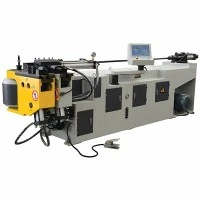



All-Electric Tube Bending Machine
The All-Electric Tube Bending Machine utilizes independent CNC servo drives for every motion axis-including bending, feeding, plane rotation, mandrel shift, and pressure die assist. By removing hydraulic circuits, this architecture eliminates thermal drift caused by oil temperature fluctuations and reduces energy consumption by up to 40% compared to traditional hydraulic equivalents.
Built on a stress-relieved Meehanite cast iron bed, the machine provides the structural rigidity required to process high-tensile stainless steel, titanium, and aluminum alloys for demanding industrial sectors.
Technical Specifications
|
Technical Parameter |
Standard Specification |
Extended / Custom Range |
|
Max. Tube Diameter |
Phi 50 x 3.0 mm (Mild Steel) |
Up to Phi 114 mm |
|
Max. Bending Radius (CLR) |
250 mm |
Customizable per tooling design |
|
Min. CLR / OD Ratio |
1.0 x OD (Dependent on material) |
Ultra-tight radius tooling packages |
|
Controlled Axes |
8 Axes (Y1, Y2, Y3, B1, C1, A1, X1, Z1) |
Up to 12 Axes |
|
Bending Accuracy |
+/- 0.05 deg |
Closed-loop angle feedback |
|
Feeding Accuracy |
+/- 0.05 mm |
Absolute encoder feedback |
|
Max. Bending Speed |
120 deg/sec |
Adjustable via NC program |
|
Drive System |
Absolute AC Servo Motors (Direct Drive) |
Liquid-cooled servo packages |
|
Operating Voltage |
380V / 50Hz / 3-Phase |
Custom local grid compliance |
Key Features
Multi-Axis Synchronized Servo Control: Eliminates mechanical backlash by coupling servo drives directly to precision planetary gearboxes and ball screws.
Dynamic Pressure Die Assist: Programmable boost force applied during the bend cycle prevents wall thinning on outer radii and eliminates wrinkling on tight inner radii of thin-walled tubes.
Automatic Springback Compensation: The control system measures material elastic recovery angle post-bend and dynamically adjusts the final axis position to hit target geometries on the first part.
Interference-Zone Collision Simulation: 3D graphical programming software calculates tool paths and checks for machine-component clearance before physical execution.
Oil-Free Clean Operation: Zero hydraulic oil leakage or filtration maintenance requirements, making it compliant with cleanroom and medical manufacturing environments.
Working Process
Material Loading: The raw tube is manually or automatically loaded into the pneumatic collet chuck on the carriage slide.
Feeding & Rotation: The carriage feeds the tube longitudinally along the X-axis while rotating it via the B-axis to position the next bend plane.
Mandrel Positioning: The internal mandrel advances to the tangent point of the bend to support the inner wall against collapse.
Bending Execution: The bend arm rotates around the center die while the pressure die and wiper die synchronize speed to draw the material uniformly.
Retraction & Unloading: The mandrel retracts slightly prior to the end of the cycle, the pressure die opens, and the finished part clears the tooling zone.
Applications
Automotive Exhaust & Fluid Lines: Processing complex multi-radius bends in stainless steel exhaust systems and chassis structural members.
Electric Vehicle (EV) Thermal Management: Bending thin-walled aluminum cooling tubes without crimping or restricting fluid flow channels.
Aerospace Fluid Conduits: Fabricating high-pressure titanium and Inconel hydraulic lines requiring strict adherence to wall thickness reduction limits.
HVAC & Refrigeration: Producing return bends and complex copper/aluminum manifolds with zero ovality.
Industrial Furniture & Equipment: High-speed batch production of structural frames with tight cosmetic standards.
Tooling & Configuration
Precision tube bending relies entirely on correct tooling geometry matched to the material yield strength.
Tooling Set Components: Bend die, clamp die, pressure die, wiper die, and internal mandrel (plug or ball link).
Material Selection: Standard tooling manufactured from hardened alloy steel (40Cr / SKD11). Anti-friction bronze or Ampco alloys available for aluminum and stainless steel applications to prevent scoring.
Quick-Change Design: Hydraulic or mechanical quick-release mechanisms allow operators to swap complete tooling stacks in under 15 minutes, minimizing changeover downtime.
Customization
Manufacturing requirements often extend beyond standard configurations. Engineering adjustments are available for:
Extended Bed Lengths: Accommodating raw tube lengths up to 6,000 mm or more.
Specialized Multi-Stack Tooling: Integration of multi-radius or left-hand/right-hand compound bending heads in a single cell.
Robotic Loading Cells: Interfacing with 6-axis articulated robots or gantry loaders for lights-out automated production.
Custom HMI Integration: Tailored PLC software communication protocols (OPC UA, Profinet) for direct integration into factory MES networks
Quality & Testing
Internal manufacturing protocols ensure structural rigidity and kinematic precision prior to factory dispatch:
Bed Machining: Machine frames are welded from heavy-wall structural steel, annealed at 650 deg C to release internal welding stress, and finished on a 5-axis CNC gantry milling center in a single setup.
Laser Interferometer Calibration: Linear axes and rotary tables are calibrated using Renishaw laser interferometers to verify positioning accuracy and repeatability.
Continuous Load Testing: Every machine undergoes a 72-hour dry-run endurance test followed by a live material test burn using customer-specified sample tubes to verify ovality and wall thinning parameters before shipment.
FAQ
Q: How does an all-electric tube bender handle springback in high-strength stainless steel compared to hydraulic models?
A: The CNC system utilizes closed-loop feedback combined with material database libraries. After an initial test bend, the controller measures the exact springback angle via encoder feedback and automatically recalibrates the over-bend angle for subsequent parts, maintaining tolerance within +/- 0.05 deg without manual operator intervention.
Q: What is the minimum centerline radius (CLR) achievable without a mandrel?
A: For standard mild steel tubing, non-mandrel bending is generally limited to a CLR of 3 x OD (Outer Diameter) without incurring wall collapse or wrinkling. For tight-radius applications down to 1 x OD or thin-walled tubes (wall thickness < 10% of OD), a multi-ball mandrel and wiper die configuration is required.
Q: Can this machine integrate with automated loading and unloading robotic cells?
A: Yes. The PLC control architecture includes standard digital I/O handshakes and Ethernet communication protocols (Profinet/Modbus) designed specifically to interface with gantry loaders, 6-axis industrial robots, and automated deburring stations.
Q: What maintenance is required for the servo-driven axes compared to hydraulic systems?
A: All-electric machines eliminate hydraulic fluid changes, proportional valve cleaning, seal replacements, and oil chiller maintenance. Maintenance is limited to scheduled greasework on linear guideways, ball screws, and periodic inspection of direct-drive gearboxes.
Q: What file formats does the CNC controller accept for programming?
A: The industrial touch-screen HMI accepts direct coordinate input (XYZ or YBC), step files (.step / .stp) via USB or network transfer, and converts CAD geometry into machine motion programs via integrated off-line bending simulation software.
Q: What is the standard delivery timeline and what factory acceptance testing (FAT) is provided?
A: Standard machine delivery ranges from 8 to 12 weeks depending on axis configuration and tooling design. Buyers are invited to our manufacturing facility for a formal FAT, where we run sample material through the machine and verify dimensional reports against your engineering drawings before crating and export.
Hot Tags: all-electric tube bending machine, China all-electric tube bending machine manufacturers, suppliers, factory, Automatic Metal Profile Circular Saw Machine, CNC Copper Pipe Bending Machine, CNC Heavy Duty Pipe Cutting Machine, CNC Pipe Bending Machine, Hydraulic Metal Tube Bending Machine, Small Diameter Metal Tube Bending Machine
Next
No InformationYou Might Also Like


Send Inquiry