


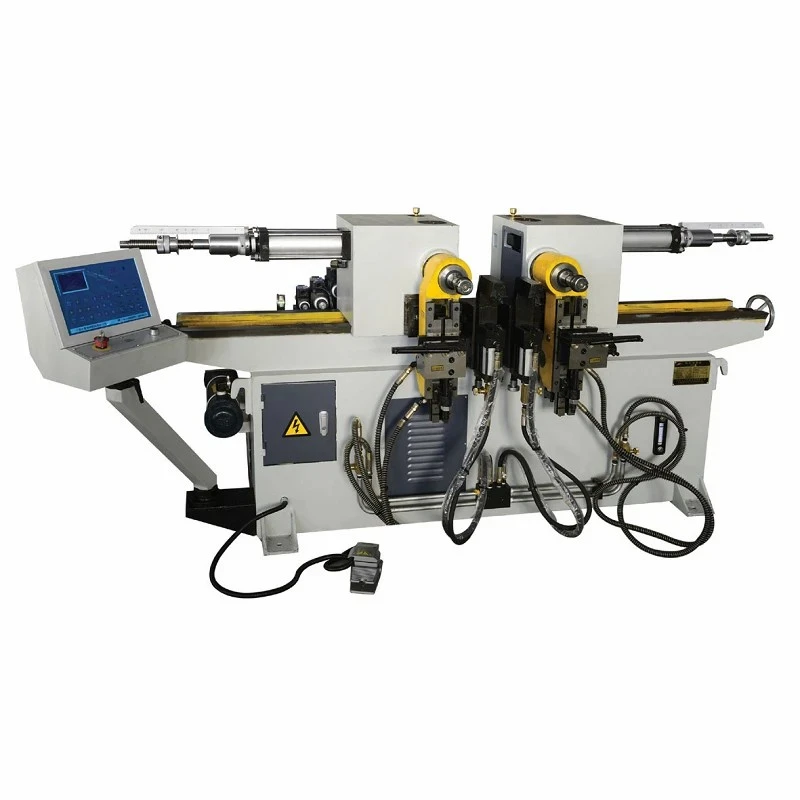
Multi-Ball Mandrel Tube Bending Machine
Multi-Ball Mandrel Tube Bending Machine
Engineered for rotary draw bending of thin-walled metal tubing with tight centerline radii (CLR <= 1.5D), this multi-ball mandrel tube bending machine prevents inner-wall wrinkling, cross-sectional flattening (ovalization), and excessive outer-wall thinning. An articulated multi-ball mandrel operates internally to support the neutral axis, while a synchronized wiper die and pressure die system control material flow. Built on a stress-relieved heavy-gauge steel frame and driven by absolute encoder servo axes, the system maintains repeatable angular accuracy within plus-minus 0.1 degrees across high-volume production in stainless steel, titanium, and alloy applications.
Technical Specifications
|
Specification Parameter |
Industrial Standard Range (Fully Customizable) |
|
Max. Tube Outer Diameter (OD) |
Phi 16 mm - Phi 120 mm (Wall thickness: 0.5 mm - 5 mm) |
|
Max. Bending Angle |
180 degrees + springback compensation |
|
Min. Centerline Radius (CLR) |
1.0D - 1.5D (Material elongation dependent) |
|
Mandrel Articulation |
2 - 12 flexible chrome-plated hardened tool steel balls |
|
CNC Axes Configuration |
5-Axis (Feeding, Rotation, Bending, Mandrel Extraction, Carriage Shifting) |
|
Drive Technology |
AC Servo Motors coupled with precision planetary gearboxes |
|
Hydraulic Assist Pressure |
14 MPa - 21 MPa (Clamp, pressure die, and extraction circuits) |
|
Power Supply Requirements |
380V/415V/480V, 50Hz/60Hz, 3-Phase |
Key Features
Rigid Machine Bed: Stress-relieved structural steel weldment minimizes torsional frame deflection during high-torque stainless steel bending cycles.
Closed-Loop Servo Architecture: Eliminates hydraulic drift; axis positioning is monitored in real-time via multi-turn absolute encoders on feeding and rotation axes.
Programmable Mandrel Retraction: Early mandrel extraction programming prevents tool scoring on interior walls as tubes reach terminal bend angles.
Synchronized Booster Carriage: Applies axial push-force during the bend to shift material toward the outer radius, directly combating thin-wall rupture risks.
Industrial HMI Control Panel: Features real-time diagnostics, I/O hardware monitoring, step-by-step coordinate programming, and 10,000+ part program memory storage.
Working Process
Loading: Raw tubing is loaded manually or via an automated magazine loader into the feed carriage collet.
Mandrel Insertion: The multi-ball mandrel advances internally, positioning the apex of the balls precisely at the tangent point of the bend die.
Clamping & Guiding: The clamp die secures the tube against the bend die, while the wiper die presses firmly against the tangent to prevent buckling.
Rotary Draw Bending: The bend arm rotates around the die spindle with hydraulic pressure die assistance. Mandrel balls remain stationary inside the bend radius, supporting the inner wall sequentially.
Extraction & Unloading: The mandrel retracts slightly to clear the newly formed radius, the clamp opens, and the carriage indexes forward for subsequent bends or unloads the finished part.
Applications
Automotive Exhaust Systems: Multi-radius exhaust headers, catalytic converter piping, and turbocharger lines requiring constant cross-sections in 304/409 stainless steel.
Aerospace Fluid Lines: Hydraulic, pneumatic, and fuel distribution lines fabricated from lightweight titanium (Grade 2/9) and inconel alloys.
HVAC & Industrial Heat Exchangers: Tight U-bends and complex return headers in copper, aluminum, and heavy-wall carbon steel tubing.
Industrial Machinery & Structural Frames: High-strength structural tubular components requiring strict aesthetic and dimensional tolerances.
Tooling & Configuration
Successful multi-ball mandrel bending relies on matched tooling geometry tailored to tube material yield strength, outer diameter, and wall thickness ratio (D/t ratio).
Mandrel Variations: Formed rigid plugs, standard multi-ball links, and ultra-short pitch balls for extreme 1.0D radii. Construction materials include hardened alloy steel, Ampco aluminum-bronze (for stainless/titanium to eliminate galling), and nylon/polypropylene inserts.
Complete Tooling Package: Supplied with a matching Bend Die, Clamp Die, Pressure Die, Wiper Die, and Mandrel Assembly.
Quick-Change Design: Quick-release keyways and hydraulic quick-clamp adapters minimize complete tooling changeover times to under 20 minutes.
Customization Options
Automatic Internal Lubrication: Integrated pneumatic mist pumps deliver metered lubricant directly to the mandrel balls to minimize friction and extend tool life.
Multi-Stack Tooling: Stacked tooling layouts allow multi-radius configurations or mixed tube sizes on a single machine setup.
Robotic Cell Integration: Customized pneumatic and electrical I/O handshaking interfaces for seamless integration with automated loading/unloading robots.
Safety & Enclosure Configurations: Sound-dampening acoustic enclosures and safety light curtains engineered to comply with local factory safety standards (CE / OSHA).
Quality Control & Testing
Consistent manufacturing performance is ensured through rigorous in-house machining and metrology protocols:
Structural Machining: Main machine bases undergo thermal annealing and stress-relief treatment before high-precision milling on large CNC floor boring machines, guaranteeing bed axis parallelism within 0.02 mm.
Transmission Verification: Backlash verification across all servo-driven axes using laser interferometer measurement systems.
Factory Acceptance Testing (FAT): Each machine undergoes a 72-hour continuous dry-run cycle test followed by live material test bends. Shipments include a complete dimensional inspection report, material certificates for critical structural components, and CMM measurement verification data for trial parts.
FAQ
Q: How do I calculate the correct number of mandrel balls required for my specific tube size?
A: The required ball count is dictated by your centerline radius (CLR) and wall thickness ratio. Tight radii (less than or equal to 1.5D) and thin walls (t/OD < 0.05) require greater articulation-typically 4 to 8 balls to support the inner wall continuously. Thicker walls or wider radii (> 2.5D) generally require fewer balls (1 to 2) or a solid plug mandrel to prevent unnecessary friction.
Q: What are the primary trade-offs between hydraulic drive and servo-electric drive for the bending axis?
A: Hydraulic drives deliver high initial torque at a lower capital expenditure, making them ideal for heavy carbon-steel piping above Phi 80 mm. Servo-electric drives eliminate oil temperature variations, provide faster acceleration/deceleration profiles, offer precise angular repeatability (plus-minus 0.05 degrees), and cut idle-period energy consumption by up to 40%.
Q: How do you prevent inner wall scoring and galling when bending stainless steel or titanium?
A: Inner wall scoring is mitigated by matching mandrel material to the tube chemistry. For stainless steel and titanium, we specify Ampco (aluminum-bronze) mandrel balls rather than hardened steel to prevent metal pickup and galling. This is paired with an integrated internal mist lubrication system to continuously reduce friction during the draw phase.
Q: Can this machine process rectangular or square structural tubing?
A: Yes, with dedicated tooling packages. Processing rectangular or square tubing requires matching wiper dies, specialized grooved clamp blocks, and segmented internal mandrels engineered to support flat sidewalls against inward collapse and bulging.
Q: What utility connections must be prepared on our factory floor prior to machine delivery?
A: Standard requirements include a stable 3-phase industrial power supply matching your local voltage, a clean and dry compressed air line (0.6 - 0.8 MPa) for pneumatic valve actuation, and standard hydraulic oil (ISO VG 46) if equipped with a hydraulic power unit. Comprehensive utility footprint drawings are supplied immediately following order confirmation.
Q: What is the standard build lead time, and what level of support is included during commissioning?
A: Standard machine fabrication and FAT lead times range from 60 to 90 days, depending on axis complexity and custom tooling requirements. Commissioning includes on-site or remote engineering support, operational training for your programmers and maintenance personnel, and lifetime remote diagnostic access through our technical service portal.
Hot Tags: multi-ball mandrel tube bending machine, China multi-ball mandrel tube bending machine manufacturers, suppliers, factory, Automatic Tube Punching Machine, CNC Oval Tube Cutter, CNC Precision Tube Sawing Machine, Furniture Pipe Bending Machine, Small Diameter Metal Tube Bending Machine, Tube Cut to Length Circular Saw Machine
You Might Also Like


Send Inquiry