

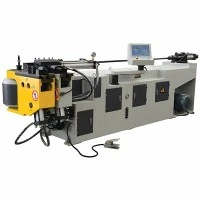

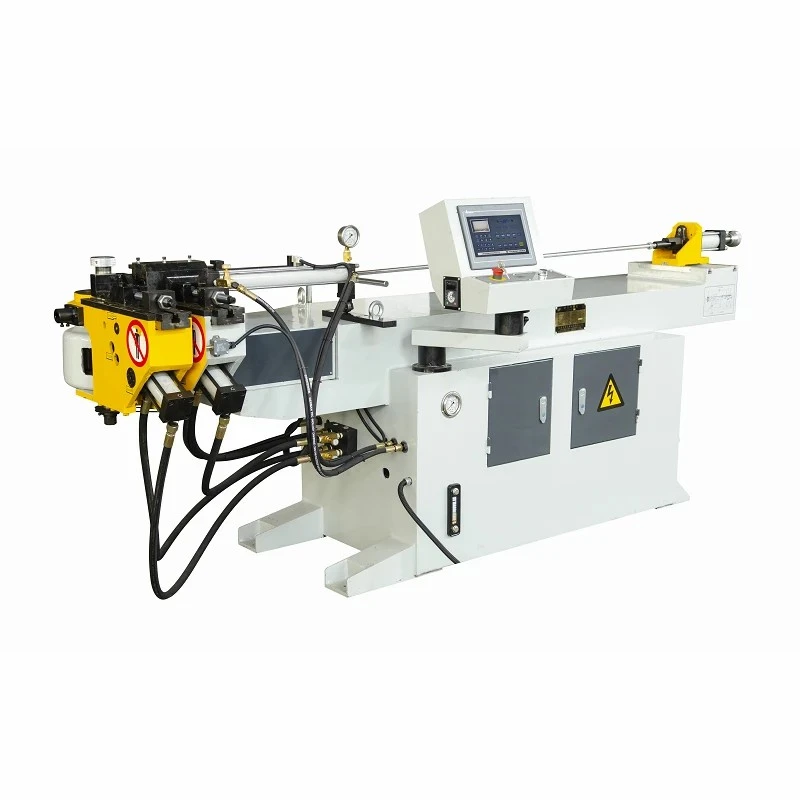
Precision Mandrel Tube Bender
The Precision Mandrel Tube Bender is engineered for high-tolerance, thin-walled metal tube fabrication where cross-sectional deformation, wall thinning, and wrinkling must be strictly controlled. Unlike standard rotary draw benders, this machine integrates a multi-axis programmable mandrel system, flexible wiper dies, and synchronized pressure die boosters to support the tube internally and externally throughout the deformation zone.
Built on a normalized heavy-plate welded steel frame processed in-house via large-scale CNC floor boring mills, the machine minimizes torsional deflection during high-pressure cycles. Drive systems utilize closed-loop servo motors coupled with high-precision planetary gearboxes on the bend, feed, and rotation axes. This architecture delivers consistent repeatability down to +/-0.05 degrees in angular precision and +/-0.1 mm in linear positioning, meeting strict dimensional compliance standards for aerospace, automotive exhaust, and fluid conveyance systems.
Technical Specifications
|
Parameter |
Standard Specification Range |
Custom Engineering Options |
|
Max. Tube Outer Diameter (OD) |
16 mm – 114 mm |
Up to 219 mm (Heavy Industrial) |
|
Max. Wall Thickness (WT) |
0.5 mm – 4.0 mm |
Up to 8.0 mm (Material dependent) |
|
Min. Centerline Radius (CLR) |
1.0 x OD (Application dependent) |
Tight-radius 0.8 x OD with specialized tooling |
|
Max. Bending Angle |
180 degrees + Springback compensation |
Up to 190 degrees |
|
Control Axes |
3-Axis to 8-Axis (YBC / YBC-P) |
Fully electric multi-stack tooling configurations |
|
Bending Precision |
+/-0.05 degrees |
Closed-loop springback auto-correction |
|
Feeding Precision |
+/-0.1 mm |
Optical encoder feedback system |
|
Rotation Precision |
+/-0.05 degrees |
Direct-drive servo indexing |
|
Hydraulic System Pressure |
14 MPa – 21 MPa |
Variable displacement pump with oil cooling |
|
Supported Materials |
Carbon Steel, Stainless Steel, Aluminum, Titanium, Copper |
Inconel, Monel, Alloy steels |
Key Features
Multi-Axis Synchronized Servo Control: Independent AC servo motors drive the feed (Y-axis), rotation (B-axis), and bend (C-axis) functions. Electronic gearing eliminates mechanical backlash common in traditional hydraulic gear trains.
Programmable Pressure Die Booster: An auxiliary hydraulic/servo booster pushes material into the bend zone during the cycle, neutralizing outer wall thinning on tight-radius bends (1.5 x OD).
Multi-Stack Tooling Stack: Accommodates multiple tooling radii on a single arbor, allowing complex multi-radius components (such as automotive exhaust manifolds) to be processed in a single handling sequence without tooling changeovers.
Industrial CNC Touch Screen Interface: Operates on an embedded industrial PC running real-time motion control software. Operators input XYZ or YBC coordinates directly, and the system auto-calculates stretch factors, elongation allowances, and theoretical interference checks.
Internal Mandrel Extraction Programming: Programmable early mandrel extraction retracts the flexible ball mandrel prior to the completion of the bend cycle, preventing inner wall scoring and friction galling on soft alloys like aluminum and copper.
Working Process
[Suggested Media: High-definition 3D animation or short clip showing synchronized mandrel movement, pressure die boost, and bend arm rotation]
Loading & Clamping: The raw tube is manually or automatically loaded onto the mandrel extension rod. The clamp die and pressure die pneumatically or hydraulically lock the tube against the bend die.
Mandrel Positioning: The internal plug or multi-ball mandrel advances past the tangent point of the bend to physically block inner-wall inward collapse.
Bending Execution: The bend arm rotates to the programmed angle (C-axis) while the pressure die booster applies forward axial force to control outer wall elongation.
Extraction & Stripping: Upon bend completion, the mandrel retracts slightly (early extraction), the clamp and pressure dies open, and the wiper die clears the component surface.
Feeding & Rotation: The carriage indexes the tube forward (Y-axis) and rotates to the spatial angle (B-axis) for the next sequential bend according to the compiled CNC part program.
Applications
Automotive Exhaust & Fluid Lines: Forming complex, multi-plane exhaust headers, turbocharger oil feeds, and chassis structural members from 304/409 stainless steel and aluminized tubing.
Aerospace Environmental Control Systems (ECS): Bending thin-walled titanium (Grade 2/Grade 9) and Inconel ducting where weight reduction, zero ovality, and strict non-destructive testing (NDT) compliance are mandatory.
HVAC & Refrigeration Coils: Processing copper and aluminum return bends and evaporator serpentine coils with tight return radii and zero cross-sectional reduction.
Industrial Machinery & Hydraulics: Fabricating high-pressure hydraulic fluid distribution lines for heavy earthmoving equipment and injection molding machines, preventing turbulent flow caused by internal ripples.
Tooling & Configuration
Achieving precision bends relies on matching machine kinematics with exact tooling geometry. Standard tooling packages are engineered based on tube material elongation limits and wall-to-diameter ratios (t/D).
Mandrel Types:
Plug Mandrels: For thick-walled tubes (t/D > 0.08) and wide radii.
Formed Ball Mandrels (Single, Double, or Multi-Link): Articulated links that travel around tight radii (1.0 to 1.5 x OD) to support the interior wall continuously through the deformation arc.
Wiper Dies: Bronze or aluminum-bronze alloy inserts positioned immediately ahead of the bend tangent point to prevent the formation of wrinkles on the inner radius of thin-walled tubes.
Die Sets Material Selection:
H13 Tool Steel (Heat Treated to 48-52 HRC): Standard for carbon and stainless steel bending.
Aluminum Bronze (NAB) / Ampco: Recommended for stainless steel and titanium processing to prevent galling and cold-welding transfer on the tube exterior.
Nylon / Ampco Bronze Blend: Used for polished or decorative stainless steel and aluminum tubes to eliminate surface scratching.
Customization
Manufacturing operations require machine configurations tailored to specific plant layouts and production bottlenecks. Engineering modifications are available based on part geometry and factory automation requirements:
Extended Bed Lengths: Carriage travel extensions to accommodate raw tube lengths up to 6,000 mm or 12,000 mm for structural scaffolding and long-span piping.
Automation Integration: Interface readiness for robotic loading/unloading gantries, automatic bundle loaders, and seam-detection optical scanners for welded tube orientation.
Specialized Control Integration: Custom PLC mapping, integration with existing factory MES/ERP networks, and offline simulation software packages (e.g., tube bending simulation modules).
Multi-Directional Bending Heads: Dual-direction (clockwise and counter-clockwise) bending configurations for complex parts requiring reverse bends without intermediate repositioning.
Quality & Testing
Machine reliability and dimensional compliance are verified through strict in-house manufacturing controls prior to factory acceptance testing (FAT):
In-House Thermal & Structural Processing: Machine frames and major weldments undergo gas-fired furnace annealing at 600 degrees Celsius to completely eliminate internal residual stresses before precision finish-machining on heavy-duty CNC floor borers.
Laser Metrology Calibration: Laser interferometer tracking is standard protocol for verifying axis parallelism, spindle runout, and linear positioning accuracy under simulated load conditions.
Live Sample Trial & CMM Verification: Every machine is test-run using customer-supplied raw material batches. Finished components are verified via Coordinate Measuring Machine (CMM) inspection to ensure ovality stays within +/-1% and springback compensation curves are fully dialed in.
Tier-1 Component Traceability: Core pneumatic, hydraulic, and motion components-including Siemens controls, Rexroth valves, and Yaskawa servo drives-are sourced directly from authorized global supply chains with full mill and compliance certificates.
FAQ
Q: How do I select between a single-ball mandrel and a multi-ball mandrel for my application?
A: Selection is dictated by the tube's wall-to-diameter ratio (t/D) and centerline radius (CLR). If the outer diameter is 50 mm, the wall thickness is 1.5 mm (t/D = 0.03), and your CLR is 1.5 x OD, a multi-ball articulated mandrel (typically 3 to 5 balls) is required to support the inner wall continuously through the bend arc and prevent collapse. For thick-walled tubing (t/D > 0.08), a simple plug mandrel or non-mandrel setup is usually sufficient.
Q: What is the maximum wall thinning percentage expected during a tight-radius bend?
A: Outer wall thinning follows predictable geometric laws governed by the expression Tf = T0 * (1 - (OD / (4 * CLR))). On a standard 1.5 x OD bend without a pressure die booster, outer wall thinning can reach 15% to 25%. Equipping the machine with a programmable pressure die booster pushes axial material into the bend zone, reducing wall thinning down to under 10%, ensuring compliance with pressure vessel and aerospace codes.
Q: How does the CNC system compensate for material springback across different metal batches?
A: Metal batches vary in yield strength and hardness even within the same grade (e.g., 304 stainless steel). The control system utilizes integrated springback compensation algorithms. After an initial test bend, the actual measured angle is fed back into the HMI. The controller automatically recalculates the over-bend angle (C-axis target) and applies proportional corrective rotation to offset elastic recovery precisely.
Q: What maintenance is required to prevent scoring and galling on stainless steel tubes?
A: Galling occurs due to friction and high local pressure between the tube exterior and the wiper die/clamp die interface. Maintenance protocols require regular cleaning of bronze/alloy tool inserts, verification of automatic lubrication pump flow (using high-pressure drawing oil or specialized synthetic grease), and periodic inspection of wiper die lead-in edge sharpness. Worn wiper dies must be re-machined or replaced before scoring occurs.
Q: Can this mandrel bender integrate with automated robotic loading cells?
A: Yes. The machine control architecture features standard hardware and software handshaking protocols (such as Ethernet/IP, Profinet, and discrete I/O interlocks) designed to interface directly with industrial loading robots, pneumatic gantries, and vertical buffer storage racks for fully unattended lights-out manufacturing.
Q: What documentation and factory acceptance testing (FAT) are provided prior to shipment?
A: Standard delivery includes complete electrical schematics, hydraulic circuit diagrams, PLC backup files, and user operation manuals in English. Prior to dispatch, clients are invited for a formal FAT where dimensional accuracy reports, CMM inspection sheets, video documentation of trial runs, and calibration certificates are executed and signed off.
Hot Tags: precision mandrel tube bender, China precision mandrel tube bender manufacturers, suppliers, factory, Automatic Profile Cutting Saw, Automatic Stainless Steel Tube Sawing Machine, Automatic Tube Punching Machine, CNC Automatic Circular Saw Machine, CNC Metal Tube Bending Machine, Fully Automatic Pipe Cutting Machine
You Might Also Like


Send Inquiry