

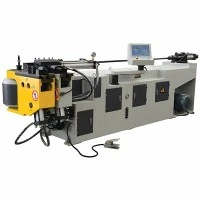



Servo Mandrel Tube Bending Machine
Servo Mandrel Tube Bending Machine
The Servo Mandrel Tube Bending Machine is a multi-axis CNC metal forming system engineered for high-precision, deformation-free pipe and tube fabrication. Driven entirely or primarily by synchronized AC servo motors, the machine controls tube feeding (Y-axis), rotation (B-axis), and bending (C-axis) simultaneously to eliminate mechanical backlash and achieve consistent dimensional accuracy across high-volume production runs.
Integrated into our 15,000 m2 heavy assembly plant-equipped with floor-boring mills and laser interferometers for structural alignment-each machine is built on a stress-relieved, annealed steel frame designed to absorb high torsional loads during severe-radius bending.
Technical Specifications
|
Specification Item |
Standard Parameter Range |
Customization Options |
|
Max. Tube Outer Diameter (OD) |
Phi 16 mm - Phi 114 mm |
Up to Phi 219 mm (Heavy-duty series) |
|
Max. Wall Thickness |
0.5 mm - 6.0 mm (Material dependent) |
High-pressure heavy-wall configurations |
|
Center Line Radius (CLR) |
1.5 x OD to 10 x OD (Standard) |
Tight-radius 1 x OD tooling available |
|
Bending Axis (C-Axis) Accuracy |
+/- 0.05 deg |
High-precision optical encoder feedback |
|
Feeding Axis (Y-Axis) Accuracy |
+/- 0.05 mm |
Rack-and-pinion or ball-screw drive |
|
Rotation Axis (B-Axis) Accuracy |
+/- 0.05 deg |
Direct-drive servo motor |
|
Max. Bending Angle |
180 deg + Springback compensation |
Multi-stack stacking capability |
|
Control System |
Industrial IPC + Real-time Multi-Axis Bus |
Siemens / Mitsubishi CNC platform |
Key Features
Multi-Axis Servo Synchronization: Eliminates mechanical gear transmission errors on Y, B, and C axes, ensuring precise spatial positioning for complex multi-plane tubular parts.
Programmable Mandrel Extraction: Servo-driven early mandrel extraction timing retracts the mandrel prior to the completion of the bend, preventing inner-wall tearing and scoring on thin-wall aluminum or titanium tubing.
Hydraulic/Pneumatic Boost Bending: Applies axial compressive force during the bend to shift the neutral axis outward, preventing excessive wall thinning on the outer radius of tight-CLR bends.
Modular Stack Tooling: Accommodates multiple stack dies on a single tower, allowing rapid pneumatic or hydraulic shifting between different radii or tube sizes without manual tooling changes.
Thermal Stability Frame: Heavy-walled structural steel tubing weldments undergo thermal annealing and precision CNC machining in a single setup to maintain geometric tolerances under continuous multi-shift operation.
Working Process
Material Loading: The raw tube is loaded manually or via an automated bundle loader onto the carriage collet.
Feeding & Positioning (Y-Axis): The servo-driven carriage clamps the tube and advances it longitudinally to the precise axial coordinate for the first bend.
Rotation Orientation (B-Axis): The collet rotates the tube to align the predetermined spatial plane angle for multi-plane configurations.
Mandrel & Wiper Die Positioning: The internal mandrel advances inside the tube to the tangent point of the bend to support the inner wall against collapse, while the wiper die prevents external wrinkling.
Bending Execution (C-Axis): The pressure die and clamp die secure the tube against the bend die. The servo-driven arm rotates to the programmed angle while the optional pressure booster pushes material into the bend zone.
Extraction & Unclamping: The mandrel retracts, the dies open, and the carriage indexes the tube for the subsequent bend or ejects the finished part.
Applications
Automotive Exhaust & Fluid Lines: Fabricating complex stainless steel catalytic converter pipes, turbocharger oil lines, and chassis structural members requiring tight tolerances and smooth internal flow.
Aerospace Tubing: Forming high-strength, thin-walled titanium and Inconel fuel, hydraulic, and pneumatic lines that demand zero surface defect rates.
HVAC & Refrigeration: Bending copper and aluminum return bends and evaporator manifolds with consistent wall thickness to withstand high internal working pressures.
Heavy Machinery Hydraulics: Processing thick-walled carbon steel hydraulic conduits for earthmoving and agricultural equipment.
Tooling & Configuration
Successful tube bending relies heavily on the correct matching of tooling components to the material grade and geometry:
Bend Die: Determines the centerline radius and outer profile; manufactured from hardened alloy steel or aluminum-bronze for abrasive materials.
Clamp Die: Grips the straight portion of the tube securely against the bend die without crushing the cross-section.
Pressure Die: Follows the tube during the bend to maintain constant forward pressure, reducing flattening.
Mandrel (Plug / Ball): Flexible multi-ball mandrels support the interior radius. Hardened steel balls are used for steel, while Ampco (aluminum bronze) balls are specified for stainless steel and titanium to prevent galling.
Wiper Die: Positioned immediately ahead of the tangent point to smooth out compressive wrinkles on tight bends.
Customization
Multi-Stack / Multi-Radius Tooling Stacks: Customized stack heights to accommodate up to four different radii on a single machine, reducing part handling in high-mix contract manufacturing environments.
Automation Integration: Interface readiness for robotic loading/unloading arms, automatic seam detectors (optical or mechanical), and automated length-measuring inspection tables.
Specialized Enclosures: Extended machine beds for extra-long chassis members or specialized structural frames configured for unique facility layouts.
Quality & Testing
Every machine undergoes strict verification before dispatch at our manufacturing facility:
Structural Inspection: Frame weldments are checked using ultrasonic testing (UT) on critical stress zones and measured on large-scale CMM (Coordinate Measuring Machines) after finish machining.
Axis Calibration: Laser interferometers verify linear positioning accuracy, while high-resolution rotary encoders test angular repeatability across 100 continuous cycle tests.
Functional Load Testing: Each machine undergoes a 72-hour dry-run endurance test followed by a live material test bending sample tubes supplied by the customer, with cross-section wall-thickness analysis performed using optical comparators.
FAQ
Q: What is the minimum centerline radius (CLR) achievable without a mandrel?
A: Generally, bending without an internal mandrel is restricted to a CLR of 3 x OD or larger, provided the wall thickness is greater than 10% of the outer diameter. For tighter radii (1.5 x OD to 2 x OD) or thin-walled tubing, a multi-ball mandrel and wiper die are mandatory to prevent wall collapse and buckling.
Q: How does servo control reduce setup time compared to traditional hydraulic machines?
A: Servo axes eliminate manual mechanical adjustments for positioning stops, flow valves, and limit switches. Programmed parameters-such as axis depths, clamping pressures, and springback compensation angles-are stored in the CNC recipe database, allowing operators to recall and setup a repeat part in under 15 minutes.
Q: Can this machine integrate with CAD/CAM software for offline programming?
A: Yes. The industrial CNC control system accepts standard .STEP, .IGES, or dedicated XYZ/LRA (Length, Rotation, Angle) data formats. Operators can import tube geometries directly, and the software automatically calculates elongation factors, springback allowances, and collision checks.
Q: What materials can be processed on a standard configuration?
A: The standard machine configuration processes carbon steel, stainless steel, aluminum alloys, copper, brass, and titanium. Harder alloys or high-tensile structural grades may require upgraded hydraulic boost pressure ratings and specialized tool steel compositions (e.g., D2 tool steel or Ampco bronze).
Q: How do you prevent wall thinning and wrinkling on thin-walled stainless steel tubes?
A: Wrinkling is prevented by utilizing a closely fitted wiper die positioned tight to the tangent point, combined with a multi-ball mandrel that supports the internal tube wall through the deformation zone. Wall thinning is counteracted by programming the programmable pressure die booster (auxiliary push) to feed material into the bend zone synchronously.
Q: What is the typical lead time and what factory testing is provided prior to shipment?
A: Standard machine lead times range from 60 to 90 days depending on axis configuration and custom tooling requirements. Prior to shipment, customers receive a detailed Factory Acceptance Test (FAT) report, including laser calibration logs, geometric accuracy certificates, and trial-bend measurement sheets. Video inspection or on-site pre-shipment sign-offs can be arranged upon request.
Hot Tags: servo mandrel tube bending machine, China servo mandrel tube bending machine manufacturers, suppliers, factory, Automatic Steel Circular Saw Machine, CNC Aluminum Tube Bending Machine, CNC Oval Tube Cutter, CNC Steel Tube Sawing Machine, Hydraulic Large Diameter Tube Bending Machine, Thick Wall Tube Circular Saw Machine
You Might Also Like


Send Inquiry