

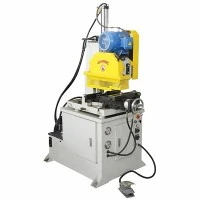

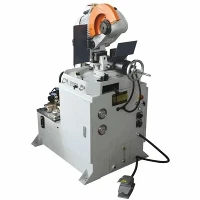


Automatic Cold Sawing Machine
Automatic Cold Sawing Machine | Industrial Technical & Procurement Guide
The Automatic Cold Sawing Machine executes high-speed, precision cut-off operations on carbon steel, alloy steel, stainless steel, and non-ferrous metal profiles. Unlike abrasive chop saws or friction saws, the low-temperature cold-cutting process transfers cutting heat into the chips rather than the workpiece, preventing thermal distortion, metallurgical changes, and heat-affected zones (HAZ).
Built on a heavy-gauge, stress-relieved steel fabrication base, the machine integrates a servo-driven material feeding system and a hydraulic clamping mechanism to maintain strict dimensional repeatability. Factory-integrated CNC controls manage programmable batch cutting, automatic sorting of crop ends, and real-time blade load monitoring, matching uninterrupted multi-shift production demands in high-output manufacturing environments.
Technical Specifications & Engineering Resources
|
Technical Parameter |
Specification Range / Standard Value |
|
Max. Cutting Capacity (Round) |
Φ15 - Φ120 mm (Model-dependent) |
|
Max. Cutting Capacity (Square/Rectangular) |
Up to 100 x 100 mm |
|
Saw Blade Diameter |
250 - 450 mm |
|
Spindle Motor Power |
5.5 - 15 kW (Inverter-controlled variable speed) |
|
Blade Spindle Speed |
30 - 200 RPM (Adjustable per material hardness) |
|
Material Feeding Stroke (Single Cycle) |
1000 mm (Auto-indexing for longer lengths) |
|
Length Cutting Tolerance |
±0.1 mm |
|
Minimum Remnant Length |
≤50 mm |
|
Hydraulic System Pressure |
5 - 7 MPa |
|
Electrical Supply |
380V, 50/60Hz, 3-phase (Customizable to regional standards) |
Key Features
Rigid Cast Iron Saw Head: Absorbs harmonic vibrations during tooth engagement, extending TCT blade edge retention and minimizing surface chatter.
Closed-Loop Servo Material Feeding: Utilizes a precision ballscrew and absolute encoder drive to eliminate slippage and position stock within ±0.1 mm tolerances.
Synchronized Vertical Slide Guidance: Employs hardened linear guideways with automatic centralized lubrication to ensure smooth vertical plunge feed and consistent cutting force distribution.
Vise Clamping Configuration: Features independent vertical and horizontal hydraulic clamps that immobilize the profile directly adjacent to the cut line, eliminating material vibration and burr formation.
Integrated Chip Management: Includes an internal scrap conveyor and high-pressure coolant flood system that clears hot swarf away from the cutting zone immediately, preventing blade clogging.
Adaptive Torque Monitoring: Continuously tracks spindle motor load; the PLC retracts the blade instantly if abnormal resistance or tooth chipping is detected.
Working Process & Operational Demonstration
Loading & Indexing: Bundled or single stock is loaded onto the inclined magazine loader. The servo gripper clamps the material and advances it to the programmed cut length against a mechanical reference stop.
Secure Clamping: Hydraulic vertical and horizontal clamping jaws engage simultaneously on both sides of the blade plane to lock the profile in position.
Lubrication Initiation: Mist or flood coolant is sprayed onto the TCT blade teeth just prior to material contact to reduce friction.
Controlled Plunge Cut: The saw head descends at a parameterized feed rate controlled by a proportional hydraulic valve, matching chip load requirements to the specific material cross-section.
Retraction & Sorting: Upon completing the cut, the saw head retracts to its home position, the clamps release, and the cut part drops into the discharge chute or sorting bin while the tailstock drops scrap remnants into a dedicated bin.
Live Cutting Cycle Preview: Watch the [High-Definition Operational Video Demo] showcasing automated bundle feeding, burr-free cross-section separation, and pneumatic sorting in a live multi-shift production facility.
Applications
Automotive Component Manufacturing: Cutting suspension tubes, steering columns, drive shafts, and exhaust system pipes requiring tight length tolerances and clean ends ready for subsequent robotic welding.
Steel Service Centers & Warehousing: High-speed batch processing of carbon steel tubes, structural channels, and solid round bars to custom customer lengths.
Industrial Furniture & Appliance Tubing: Producing burr-free thin-walled steel tubing for desk frames, shelving units, and appliance internal chassis structures.
Heavy Machinery & Equipment: Sizing hydraulic cylinders, structural brackets, and spacer bars manufactured from medium-carbon and alloy steels.
Tooling & Configuration
TCT Saw Blades: Utilizes industrial Tungsten Carbide Tipped blades (285 mm to 425 mm diameter) with specialized tooth geometries (P.V.D. coated) optimized for stainless steel, structural carbon steel, or non-ferrous applications.
Bundle Cutting Attachments: Optional multi-layer V-block jaws allow simultaneous cutting of multiple smaller tubes or bars per cycle, increasing output volume.
Unloading Conveyor Systems: Scalable auto-sorting tables equipped with pneumatic ejectors to separate short scrap crop ends from finished cut parts.
Mist Coolant System (MQL): Minimum Quantity Lubrication system that delivers micro-droplets of synthetic oil directly to the cutting edge, eliminating post-cut part washing requirements.
Customization
Manufacturing operations require machine adaptation to specific shop floor constraints and material portfolios. Engineering configurations include:
Custom Jaw Profiles: Precision CNC-machined clamping jaws contoured to irregular hollow extrusions, hex bars, or specialized structural profiles to prevent surface crushing.
Extended Infeed/Outfeed Automation: Integration with gantry loaders, bundle unscramblers, and robot transfer arms for lights-out automated cells.
Voltage & Safety Integration: Adaptation to regional electrical standards (UL/CSA compliant control panels, NFPA 79) and specialized safety interlock guarding packages.
Quality & Testing
Production consistency relies on rigorous internal fabrication and assembly protocols implemented at our manufacturing facility:
Structural Machining: Main machine beds and saw heads are milled on large-format CNC gantry boring machines in a temperature-controlled environment to maintain geometric parallelism within 0.02 mm over a 1 meter span.
Stress Relief: Welded steel fabrications undergo thermal annealing and vibrational stress relief prior to finish machining to eliminate residual structural warping.
Component Inspection: Incoming hydraulic manifolds, servo motors, and electrical switchgear are verified using CMM (Coordinate Measuring Machines) and electrical load benches.
Factory Acceptance Testing (FAT): Every assembled cold saw undergoes a continuous 8-hour dry-run cycle test followed by actual metal cutting trials using standard test profiles to verify cutting squareness, length repeatability, and vibration thresholds before crating. Buyers are invited to participate in physical or live-streamed FAT sessions utilizing their own supplied material samples.
FAQ
Q: What is the maximum wall thickness and material hardness this machine can process?
A: The machine cuts carbon and alloy steels up to HRC 40 hardness. For wall thickness limits, hollow profiles up to 12 mm wall thickness and solid bars up to Φ120 mm can be processed efficiently, depending on the specific model and blade tooth pitch selected.
Q: How does a cold sawing machine prevent burrs compared to friction or abrasive cutting?
A: Cold sawing uses a rigid TCT circular blade driven at low RPMs (30 - 200 RPM) with positive rake angles that shear the metal cleanly. This generates a continuous thick chip that carries away the cutting heat, leaving a cool, smooth edge with zero thermal discoloration and virtually no exterior or interior burr.
Q: What is the typical blade lifespan, and how are replacement costs managed?
A: Blade life depends heavily on material grade, wall thickness, and proper feed rate programming. On standard structural carbon steel tubing, a high-grade TCT blade yields between 3,000 to 6,000 cuts before requiring professional resharpening. Blades can typically be resharpened 4 to 6 times.
Q: Can the machine integrate with existing downstream deburring or washing equipment?
A: Yes. The PLC control system features standard digital I/O handshaking protocols (such as Ethernet/IP or potential-free relay contacts) to synchronize operations with downstream chamfering machines, washing units, or automated measuring tables.
Q: What utilities are required on the shop floor for installation?
A: Installation requires a 3-phase industrial power supply (380V/415V/480V as specified), compressed air supply at 0.6 - 0.8 MPa for pneumatic cylinder actuation, and a secure, level concrete foundation slab capable of supporting the machine weight (1,800 - 3,500 kg).
Q: What is the standard delivery lead time and factory acceptance procedure?
A: Standard machine configurations ship within 4 to 6 weeks from order confirmation. Custom tooling or integrated automation lines require 8 to 12 weeks. Clients can schedule an onsite or remote Factory Acceptance Test (FAT) to review tolerance reports and test-cut samples before final shipment sign-off.
Hot Tags: automatic cold sawing machine, China automatic cold sawing machine manufacturers, suppliers, factory
Previous
Industrial Cold Saw MachineYou Might Also Like


Send Inquiry