

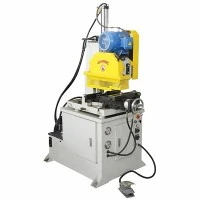

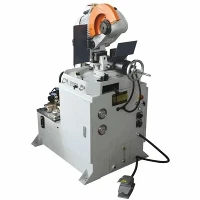


Industrial Cold Saw Machine
An industrial cold saw machine is engineered for high-precision, burr-free cutting of structural steel, carbon steel, stainless steel, and non-ferrous metal profiles. Unlike abrasive chop saws or friction saws, a cold saw transfers the heat generated during cutting into the steel chips rather than the workpiece or the blade. This mechanical process delivers a cool-to-touch, ready-to-weld cut surface straight off the machine, eliminating secondary grinding and deburring operations. Built on a heavy-gauge, stress-relieved steel welded frame, the machine minimizes vibration during heavy-feed operations, ensuring tight dimensional tolerances across multi-shift production schedules.
Technical Specifications
|
Model |
ICS-75NC |
ICS-100NC |
ICS-120CNC |
|
Max. Cutting Capacity (Round Tube) |
Φ 15 - 75 mm |
Φ 20 - 100 mm |
Φ 30 - 120 mm |
|
Max. Cutting Capacity (Square Tube) |
60 x 60 mm |
90 x 90 mm |
100 x 100 mm |
|
Max. Cutting Capacity (Solid Bar) |
Φ 45 mm |
Φ 65 mm |
Φ 85 mm |
|
Saw Blade Dimensions |
Φ 285 - 315 mm |
Φ 315 - 360 mm |
Φ 360 - 425 mm |
|
Spindle Speed (Infinitely Variable) |
30 - 120 RPM |
25 - 100 RPM |
20 - 85 RPM |
|
Main Motor Power |
5.5 kW |
7.5 kW |
11 kW |
|
Feeding Stroke Length (Single) |
600 mm |
800 mm |
1000 mm |
|
Feeding Accuracy |
± 0.08 mm |
± 0.05 mm |
± 0.03 mm |
|
Operating Air Pressure |
0.6 - 0.8 MPa |
0.6 - 0.8 MPa |
0.6 - 0.8 MPa |
|
Machine Weight |
1450 kg |
2100 kg |
3200 kg |
Key Features
Rigid Cast Iron Gearbox: Houses precision ground helical gears running in an oil bath, dampening harmonic vibrations and extending saw blade service life by up to 40% compared to belt-driven alternatives.
Dual-Direction Hydraulic Clamping: Vise jaws clamp both sides of the cut line simultaneously, securing thin-walled tubes against deformation and preventing material rotation during exit breakout.
Programmable Servo Feeding: Driven by an industrial AC servo motor coupled to a zero-backlash planetary gearbox and high-precision ball screw, achieving consistent indexing length for high-volume batch cutting.
Integrated Mist Lubrication System: Applies a metered micro-dose of synthetic lubricant directly to the tooth gullet, preventing chip welding and reducing thermal stress on carbide tips without flooding the shop floor.
Automated Scrap Sorting: PLC-controlled pneumatic sorting gate separates head cuts and tail remnants from usable cut parts, routing waste into dedicated bins during unattended runs.
Working Process
Material Loading: Raw stock bundles are placed onto the inclined storage rack, where a pneumatic singulator drops individual bars onto the powered infeed roller conveyor.
Length Indexing: The material advances through the front vise to the mechanical length stop or servo-driven pusher carriage based on the programmed cut list.
Clamping & Engagement: Vertical and horizontal hydraulic vises lock the workpiece securely. The main spindle lowers the rotating carbide blade at a controlled feed rate determined by material hardness.
Cutting & Coolant Application: The blade teeth shear through the material while the mist lubrication system maintains optimal tooth temperature.
Retraction & Sorting: Upon completing the stroke, the saw head retracts vertically to its home position, vises unclamp, and the finished component advances or drops into the collection hopper.
Applications
Automotive Exhaust & Chassis Lines: Cuts high-tensile alloy steel tubes and catalytic converter housings to exact lengths with zero inner burrs, preparing components directly for automated robotic welding cells.
Structural Steel & Scaffold Manufacturing: Processes heavy structural channels, angle irons, and square structural tubing for construction frameworks where squareness tolerances directly impact assembly fit-up.
Metal Service Centers: Handles high-mix, high-volume jobbing orders requiring rapid changeovers between solid carbon steel bars and stainless steel pipes.
Furniture & Fitness Equipment: Delivers clean 90-degree and miter cuts on thin-walled carbon steel tubing used in commercial gym equipment frames.
Tooling & Configuration
Saw Blade Selection: Utilizes Tungsten Carbide Tipped (TCT) circular saw blades ranging from 60 to 90 teeth depending on wall thickness. Standard kerf width is maintained between 2.0 mm and 2.8 mm to minimize material wastage.
Control System Integration: Standard configuration runs on an industrial-grade PLC with a 10-inch touchscreen HMI supporting Ethernet/IP and RS485 communication protocols for factory MES integration.
Material Handling Modules: Configurable with 3-meter to 6-meter motorized infeed loading tables, bundle loaders, and outfeed sorting conveyors to match shop floor layout constraints.
Customization
Custom Vise Jaw Profiles: Engineered matched-radius clamping jaws milled from tool steel to fit specific irregular or proprietary extruded aluminum profiles without crushing thin walls.
Miter Cutting Configuration: Swiveling saw head variants capable of automated angular indexing from 0° to 45° (left and right) for structural framing applications.
Voltage & Pneumatic Adaptation: Electrical enclosures built to comply with specific regional standards (e.g., NFPA 79 for North America, CE requirements for Europe) utilizing Schneider or Siemens switchgear.
Quality & Testing
Structural integrity starts in our fabrication facility, where all machine bases are cut using CNC laser systems, annealed at 600°C to release internal welding stresses, and precision-machined on multi-axis CNC gantry mills in a temperature-controlled environment.
Every cold saw machine undergoes a strict 72-hour continuous dry-run test prior to crating. Quality control inspectors verify spindle runout to within 0.01 mm, check hydraulic circuit pressure stability under full load, and execute a laser interferometer calibration test to verify linear positioning accuracy. Inspection reports, material mill test certificates, and CE/ISO 9001 compliance documentation ship standard with every unit.
FAQ
Q: What is the maximum wall thickness this cold saw can cut without damaging the blade?
A: The machine handles solid bars up to 85 mm in diameter and structural tubes with wall thicknesses up to 12 mm using standard carbide-tipped blades. For heavy-wall applications exceeding 15 mm, custom tooth pitch configurations and reduced spindle speeds are required to prevent premature tooth chipping.
Q: How does a cold saw prevent burrs compared to a band saw or abrasive saw?
A: A cold saw relies on high-torque, low-RPM shear cutting using rigid carbide teeth. The clean mechanical fracture cleanly separates the metal grain without melting or dragging material across the cut edge, leaving a square, burr-free finish that requires no secondary grinding.
Q: What is the typical blade life, and how is blade sharpening managed?
A: Blade life depends on material hardness and wall thickness, averaging between 3,000 to 5,000 cuts per sharpening cycle on standard carbon steel tubes. Blades feature repositionable carbide tips and can be reground 4 to 6 times using a standard CNC tool grinder.
Q: Can this machine integrate with existing ERP or production management software?
A: Yes. The onboard PLC supports standard industrial communication protocols including Modbus TCP and Ethernet/IP, allowing operators to download cutting lists directly from an external ERP or MES database.
Q: What is included in the standard warranty, and how is after-sales technical support handled?
A: Every machine ships with a 12-month standard warranty covering all core mechanical and electrical components (excluding normal wear parts like saw blades and seals). Technical support is provided globally via remote video diagnostics and PLC log analysis, backed by stocked replacement parts (such as standard gearboxes and Schneider/Siemens electrical modules) ready for international dispatch to minimize downtime.
Q: What are the installation requirements and commissioning options?
A: The machine requires a 3-phase power supply (standard 380V/480V, 50/60Hz), a compressed air line delivering 0.6 - 0.8 MPa of dry air, and a concrete floor of at least 150 mm thickness. Commissioning is supported through detailed engineering manuals, step-by-step video setup guides, and optional on-site engineer deployment for physical installation and operator training.
Hot Tags: industrial cold saw machine, China industrial cold saw machine manufacturers, suppliers, factory
Previous
No InformationYou Might Also Like


Send Inquiry