




Carbide Cold Saw Machine
Carbide Cold Saw Machine
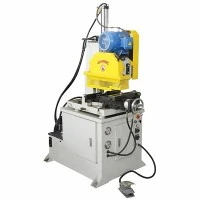
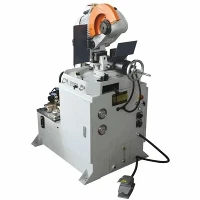
The Carbide Cold Saw Machine executes high-speed, precision separation of metal profiles, tubes, and solid bars using tungsten carbide-tipped (TCT) circular blades. Unlike abrasive friction saws or traditional bandsaws, the cold cutting process transfers cutting heat into the chips rather than the workpiece or blade. This leaves components cool to the touch immediately after the cut, producing a clean, near-net-shape cut face free of thermal distortion, structural hardening, or heavy burrs.
Engineered for high-duty-cycle production environments, the machine integrates rigid Meehanite cast iron saw heads, precision servo-driven ball screw feeding, and hydraulic multi-point clamping to eliminate vibration during high-feed-rate operations. Manufacturing facilities leverage this system to eliminate secondary deburring and end-facing processes, compressing cycle times in high-volume tube mills and structural steel service centers.
Technical Specifications
|
Technical Parameter |
Standard Duty Model (CS-65) |
Heavy Duty Model (CS-100) |
High-Capacity Model (CS-150) |
|
Max. Round Tube Capacity |
Phi 15 - 65 mm |
Phi 20 - 120 mm |
Phi 30 - 165 mm |
|
Max. Solid Bar Capacity |
Phi 15 - 45 mm |
Phi 20 - 80 mm |
Phi 30 - 120 mm |
|
Blade Diameter Range |
250 - 315 mm |
360 - 460 mm |
500 - 600 mm |
|
Spindle Speed (Infinitely Variable) |
60 - 200 RPM |
40 - 150 RPM |
30 - 100 RPM |
|
Main Motor Power |
7.5 kW |
15 kW |
22 kW |
|
Saw Blade Feed Drive |
AC Servo Motor + Precision Ball Screw |
AC Servo Motor + Precision Ball Screw |
Heavy Hydraulic Cylinder + Proportional Valve |
|
Material Clamping System |
Dual Hydraulic Vise (Vertical + Horizontal) |
Multi-Point Hydraulic Clamping Vise |
4-Side Synchronized Hydraulic Clamping |
|
Cutting Length Tolerance |
+/- 0.1 mm (at 100 mm length) |
+/- 0.15 mm (at 100 mm length) |
+/- 0.2 mm (at 100 mm length) |
|
Minimum Remnant Length |
<= 50 mm |
<= 60 mm |
<= 80 mm |
Key Features
Rigid Meehanite Cast Iron Saw Head: Absorbs high-frequency harmonic vibrations generated during tooth impact, extending carbide tip retention and reducing surface finish chatter marks.
Closed-Loop Servo Feed Control: Modulates the feed rate dynamically based on load feedback sensors, protecting the blade against overload when encountering hard spots in alloy steels.
Synchronized Mist Lubrication System: Applies controlled micro-amounts of synthetic fluid directly to the cutting edge to reduce friction and eliminate chip welding without flooding the workspace.
Dual-Direction Hydraulic Clamping: Secures the material firmly on both sides of the cut line to prevent material whip, vibration, and edge chipping during break-through.
Automated Chip Evacuation: Equipped with a built-in scraper chain conveyor that continuously clears high-density metal chips out of the cutting zone to prevent chip jamming.
Working Process
Material Loading & Positioning: Raw tubes or bars feed automatically into the cutting zone via a bundle loader and servo-driven roller measuring table to the programmed cut length.
Hydraulic Clamping: Dual-axis hydraulic vises clamp the workpiece firmly on both the fixed side and the scrap side to isolate the cut area from vibration.
Blade Engagement & Acceleration: The TCT blade reaches operational spindle speed before the servo feed system advances the saw head horizontally/vertically into the workpiece at a controlled entry rate.
Controlled Cutting Stroke: The blade traverses the material at a constant chip load per tooth, maintained by the closed-loop servo feed system.
Retraction & Unclamping: Upon completing the cut, the saw head retracts rapidly to home position, the clamping vises release, and the cut part drops onto the sorting conveyor while the tail stock ejects the remnant.
Applications
Automotive Component Manufacturing: Cutting precision tubing for exhaust systems, drive shafts, seating frames, and chassis structural members requiring strict length tolerances and zero internal burrs.
Structural Steel & Profile Fabrication: Sizing carbon steel channels, square tubes, and angle irons for construction frameworks and equipment chassis.
Metal Service Centers & Steel Stockholders: Processing high volumes of stainless steel, alloy steel, and carbon steel round bars for distribution to machine shops.
Tube & Pipe Mills: Inline flying or stop-cut applications downstream of high-frequency induction welding (HFW) tube mills operating at continuous line speeds.
Tooling & Configuration
TCT Saw Blade Selection: Performance depends on tooth geometry and carbide grade. Standard configurations utilize PVD-coated cermet or tungsten carbide tips optimized for specific material hardness classes (HRC 20 to 45).
Infeed and Outfeed Handling Integration: Configurable with pneumatic bundle loaders, gravity magazine racks, sorting tables, and automated scrap separation bins.
Mist Generation Setup: Integrates standard minimum quantity lubrication (MQL) pumps utilizing biodegradable fatty alcohol polyglycol lubricants.
Electrical Architecture: Standard PLC and HMI control packages support Siemens or Allen-Bradley hardware configurations to match plant-wide automation standards.
Customization
Custom Jaw Profiles: Vise jaws match specific geometric profiles (hexagonal bars, asymmetrical channels, multi-cavity extruded aluminum tubes) to prevent surface crushing.
Extended Capacity Frames: Bed lengths and measuring stops extend to handle raw stock lengths up to 12 meters.
Data Integration: Custom fieldbus interfaces (Profinet, Ethernet/IP, Modbus TCP) tie machine status, piece counts, and error logs directly into plant MES systems.
Exhaust Hoods & Enclosures: Full sound-attenuation and chip-containment enclosures reduce shop-floor decibel levels below 80 dB(A).
Quality & Testing
Structural Machining: Machine beds and saw slides undergo precision CNC milling on horizontal machining centers followed by stress-relieving thermal annealing to eliminate residual welding and casting stresses.
Spindle Runout Inspection: Spindles undergo dynamic balancing and laser interferometer testing to maintain radial and axial runout within 0.008 mm.
Factory Acceptance Testing (FAT): Every machine undergoes a mandatory 8-hour continuous dry-run test followed by actual material cutting trials using client-specified sample tubes to verify surface finish roughness (Ra <= 3.2 um) and length accuracy prior to crating.
FAQ
Q: What is the maximum wall thickness and hardness this machine can cut?
A: The machine handles carbon and alloy steel tubes with wall thicknesses up to 20 mm and material hardness up to HRC 45. For materials exceeding HRC 45, specialized tooth pitch configurations and reduced cutting speeds are required.
Q: How many cuts can a single TCT blade perform before sharpening?
A: Blade lifespan depends on material grade, wall thickness, and feed rate consistency. Cutting standard OD 60 mm x 3 mm carbon steel tubing typically yields between 4,000 to 8,000 cuts per sharpening cycle when using proper MQL lubrication.
Q: Can this machine cut non-ferrous metals like aluminum or copper?
A: Yes. By adjusting the spindle speed upward and utilizing carbide blades with positive rake angles and chip-breaker geometries, the machine achieves high-speed aluminum extrusion cutting without blade clogging.
Q: What utilities are required on the factory floor?
A: The system requires a standard 3-phase industrial power supply (380V/480V, 50/60Hz), a compressed air supply at 0.6 MPa for pneumatic components, and a standard shop-air line for the mist lubrication unit.
Q: How does the cold saw prevent burrs compared to friction cutting?
A: The mechanical shearing action of individual carbide teeth shears the metal cleanly at a controlled feed rate. This prevents the localized melting and re-solidification characteristic of abrasive friction cutting, eliminating external and internal burrs.
Q: What is the standard delivery lead time for a customized configuration?
A: Standard configurations ship within 8 to 10 weeks. Fully integrated lines requiring custom profile clamping jaws, extended outfeed sorting systems, and specific MES protocol integration require 12 to 16 weeks.
Hot Tags: carbide cold saw machine, China carbide cold saw machine manufacturers, suppliers, factory
You Might Also Like



Send Inquiry