

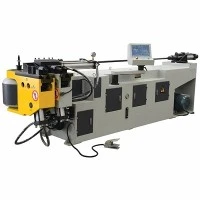


Electric Tube Bending Machine For Aluminum Profiles
The CNC Electric Tube Bending Machine is engineered for high-precision, distortion-free processing of aluminum profiles, round tubes, and complex hollow extrusions. Utilizing multi-axis absolute servo control, this machine delivers synchronized feeding, rotation, and bending to eliminate hydraulic fluid contamination, reduce energy consumption by 35% compared to hydraulic systems, and maintain tight dimensional repeatability for high-volume industrial production.
Technical Specifications
|
Parameter |
Specification Range / Standard |
|
Max. Tube Diameter (Round) |
Up to Ø120 mm (customizable up to Ø160 mm) |
|
Max. Profile Dimensions |
120 mm x 120 mm (Square/Rectangular) |
|
Max. Wall Thickness |
0.5 mm - 6.0 mm (Material dependent) |
|
Min. Center Line Radius (CLR) |
1.5 x D (Depending on tooling and alloy) |
|
Controlled Axes |
5 to 8 Axes (Y, B1, B2, C1, C2, A, X1, X2) |
|
Bending Accuracy |
+/- 0.05 deg via direct-drive servo gearboxes |
|
Feeding Accuracy |
+/- 0.03 mm via rack-and-pinion servo drive |
|
Drive System |
Full Electric Servo (Mitsubishi / Yaskawa servo motors) |
|
Control System |
Industrial IPC with 3D Simulation & Touchscreen GUI |
|
Max. Bending Speed |
120 deg/sec |
Key Features
Full Electric Servo Architecture: Eliminates hydraulic power units, reducing thermal drift, eliminating oil leakage risks, and delivering precise torque feedback essential for soft-alloy aluminum deformation control.
Dynamic Springback Compensation: Integrated algorithms calculate material rebound angles in real-time based on extrusion temper (e.g., 6063-T5, 6061-T6) and wall thickness, ensuring first-part-right output.
Programmable Mandrel Extraction: Servo-controlled early extraction timing prevents inner-wall wrinkling and cross-section collapse during tight-radius bends on thin-walled profiles.
Anti-Scratch Clamping Design: Non-marking wiper dies and pressure die assist mechanisms prevent surface scuffing on polished or anodized architectural aluminum profiles.
Modular Industrial Frame: Stress-relieved heavy steel weldment annealed at 600 deg C to eliminate internal structural tension, ensuring deflection resistance under maximum bending loads.
Working Process
Material Loading: The aluminum profile is loaded onto the feed carriage manually or via an automated bundle loader.
Mandrel Positioning: The internal mandrel advances to the tangent point of the bend to support the inner wall and prevent flattening.
Feeding & Rotation: Servo motors position the tube linearly (Y-axis) and rotationally (B-axis) for the first bend coordinate.
Bending Execution: The C-axis bend arm rotates around the center former while the pressure die and booster apply synchronized forward thrust to counteract thinning on the outer radius.
Unclamping & Extraction: The clamping die releases, the mandrel retracts slightly before the final stripping phase, and the cycle repeats for multi-radius complex geometries.
Applications
Automotive: EV battery cooling tubes, structural crash members, and sunroof guide rails made from 6000-series aluminum alloys.
Architectural Systems: Curtain wall mullions, structural canopy frames, and curved window framing profiles requiring zero surface distortion.
HVAC & Refrigeration: Return bends and complex manifolds in copper-alternative aluminum heat exchangers.
Industrial Equipment: Robotic arms, conveyor guide rails, and lightweight machine enclosures.
Tooling & Configuration
Tooling Material Selection: Tooling sets are precision-machined from Ampco bronze, hardened tool steel (H13), or nylon/delrin inserts depending on profile abrasiveness and cosmetic requirements.
Standard Tooling Package: Includes bending die, clamp die, pressure die, wiper die, and standard mandrel plugs matched to the client's specific CAD profile drawing.
Quick-Change Tooling System: Hydraulic or mechanical quick-release arbors enable complete tooling changeovers in under 15 minutes, minimizing line downtime for multi-product batch runs.
Customization
Multi-Stack Tooling: Configurable with two or three tool stacks for variable-radius bending within a single setup.
Automation Integration: Seamlessly interfaces with robotic loading/unloading arms, automatic punch/drill heads, and industrial conveyor systems for unmanned cells.
Specialized Cross-Sections: Custom wiper dies and segmented mandrels engineered specifically for asymmetric extruded aluminum profiles, hollow channels, and multi-void thermal break sections.
Quality & Testing
In-House Machining Capabilities: Critical structural frames, gearboxes, and main spindles are machined on 5-axis DMG MORI CNC boring mills to maintain geometric tolerances within +/- 0.01 mm.
Rigorous Factory Acceptance Testing (FAT): Every machine undergoes a mandatory 72-hour continuous dry-run test followed by live material trials using the customer's actual aluminum profile samples.
Dimensional Inspection: Finished bend samples are verified using laser trackers and FARO arms to cross-check centerline radii, angular deviation, and ovality rates against client CAD data.
FAQ
Q: How does an electric tube bender prevent surface scratching on anodized aluminum profiles?
A: The machine utilizes non-marking polyurethane pressure inserts, low-friction bronze wiper dies, and programmable clamping pressure control. Because the feeding and clamping motions are managed by independent servo axes rather than high-pressure hydraulic cylinders, surface friction and pressure spikes are minimized, protecting finished architectural finishes.
Q: What is the typical tooling lifespan when processing 6063-T5 aluminum extrusions?
A: Wiper dies and mandrels typically process between 50,000 to 100,000 bends before requiring maintenance or re-machining, depending on wall thickness, lubrication quality, and whether the aluminum has an abrasive mill finish or protective coating.
Q: Can this machine handle asymmetric hollow aluminum profiles without collapsing the inner walls?
A: Yes. By utilizing a multi-link flexible mandrel (plug or ball mandrel) combined with servo-controlled early mandrel extraction and a programmable booster die, the machine maintains internal cavity support through the entire bending arc to prevent wrinkling or flattening.
Q: What is required for installation and operator training?
A: The machine operates on standard industrial 3-phase power (380V/415V, 50/60Hz) with compressed air (0.6 MPa). We provide complete on-site or remote installation, PLC/IPC programming training, and geometric calibration by our senior commissioning engineers.
Q: How are software updates and remote diagnostics handled?
A: The control system features an industrial PC with built-in Ethernet connectivity. Our engineering team can securely log into the PLC via VPN for remote troubleshooting, parameter optimization, and software updates without disrupting plant operations.
Q: What is the standard lead time for a custom-tooled machine?
A: Standard configurations ship within 45 to 60 days. Units requiring custom multi-stack tooling designed specifically for complex architectural or automotive aluminum extrusions typically require 75 to 90 days, which includes sample testing and trial sign-off prior to shipment.
Hot Tags: electric tube bending machine for aluminum profiles, China electric tube bending machine for aluminum profiles manufacturers, suppliers, factory, Automatic Oval Tube Production Cutting Machine, Automatic Steel Circular Saw Machine, Automatic Tube Bending Machine, CNC Alloy Steel Circular Saw Machine, CNC Automatic Circular Saw Machine, Rectangular Metal Pipe Cutting Machine
Previous
No InformationYou Might Also Like


Send Inquiry