

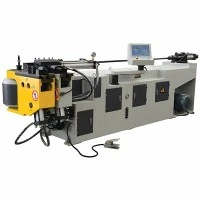



Multi-Radius Servo Tube Bender
The Multi-Radius Servo Tube Bender is engineered for complex, high-precision tubular components requiring multiple centerline radii (CLR) and compound bends within a single setup. Driven by multi-axis absolute servo motors, the machine eliminates manual part transfer between different bending stations, reducing cycle times and eliminating cumulative positioning errors in high-volume production lines.
Built on a normalized, stress-relieved steel weldment frame, the machine absorbs high torsional loads during heavy-wall or high-tensile tube forming. CNC architecture integrates real-time springback compensation algorithms, feeding correction data directly to the servo slides based on material batch variance.
Visual Proof Recommendation: Embed a 15-second high-definition video loop here displaying synchronous multi-axis movement during a complex chassis tube transition.
Technical Specifications
|
Specification Item |
Industrial Standard Range |
|
Max. Tube Outer Diameter (OD) |
10 mm – 89 mm (Custom up to 120 mm) |
|
Max. Wall Thickness |
0.8 mm – 4.0 mm (Material dependent) |
|
Min. Centerline Radius (CLR) |
1xD to 3xD (Tooling dependent) |
|
Controlled Servo Axes |
7 to 9 Axes (Feed, Rotation, Bending, Carriage Shift, Plane Shift, Mandrel Extraction, Pressure Die) |
|
Bending Precision |
+/- 0.05 deg (Rotational & Bending) |
|
Max. Bending Angle |
180 deg + Springback allowance |
|
Drive System |
Absolute AC Servo Motors with Planetary Gearboxes |
|
Control System |
Industrial CNC with 15-inch Touch Screen (EtherCAT bus communication) |
|
Power Supply |
380V / 415V, 50/60 Hz, 3-Phase |
Key Features
Independent Multi-Stack Tooling Stack: Accommodates multiple radius dies simultaneously on a vertical or horizontal slide shift, allowing automatic transition between tight and wide radii without manual intervention.
Closed-Loop Servo Pressure Die Assist: The pressure die booster synchronizes with the bend arm via dedicated servo drives to prevent wall thinning and flattening on small CLR bends of thin-walled stainless steel or titanium tubing.
Programmable Early Mandrel Extraction: Mandrel retraction timing is controlled down to the millisecond via CNC program to eliminate interior tube wrinkling and reduce friction marks at the tangent point.
Rigid Carriage Design: Linear guide rails paired with precision ball screws maintain longitudinal feeding stability up to 1,500 mm/s under maximum payload.
In-House Structural Machining: Machine beds are annealed at 650 deg C to release internal welding stress, then finished on dual-gantry CNC milling centers in a temperature-controlled facility to guarantee slide parallelism within 0.02 mm/m.
Working Process
Loading & Clamping: The raw tube is loaded onto the feed carriage. The collet grips the tube end, positioning it for the first bend coordinate.
Axis Positioning: Servo motors drive the carriage to the programmed axial distance (Y) and rotational angle (B), while the stack shift aligns the specified radius die (C).
Mandrel & Pressure Positioning: The mandrel advances inside the tube to the tangent point, and the pressure die applies matching counter-pressure.
Multi-Radius Bending Execution: The servo bend arm rotates to the target angle while the booster pushes material into the die cavity to control wall thinning on the outer radius.
Extraction & Progression: The pressure die releases, the mandrel retracts partially, and the carriage indexes the tube to the next bend station or rotation plane.
Applications
Automotive Exhaust & Fluid Lines: Forming complex exhaust pipes, EGR tubes, and chassis structural reinforcements from 304/409 stainless steel and aluminized steel.
Aerospace & Defense: Fabricating lightweight hydraulic fluid lines and structural conduit from high-strength aluminum alloys (6061-T6) and Inconel.
HVAC & Refrigeration: Bending copper and aluminum return bends and evaporator coils with strict ovality limits to prevent flow restriction.
Commercial Furniture & Fitness Equipment: Processing high-tensile structural steel tubes for exercise machinery frames and ergonomic office seating.
Tooling & Configuration
Tooling Materials: Standard tooling utilizes high-alloy tool steel (SKD11/D2) through-hardened to HRC 58-60. For abrasive stainless steel or titanium applications, titanium nitride (TiN) coated or Ampco bronze wiper dies are specified.
Configuration Options:
Standard Setup: Single-stack multi-radius (suitable for parts requiring two distinct radii).
Heavy-Duty Setup: Triple-stack configuration for complex components requiring variable radii, push-bending capabilities for tight bends (1xD), and integrated weld-seam detection cameras.
Automation Add-ons: Compatible with robotic loading/unloading gantry systems and automatic optical measurement cells.
Customization
Engineering modifications are accommodated based on specific plant layout and workpiece geometry constraints:
Specialized Bending Heads: Extended or slim-profile bend heads to clear complex multi-bend interference geometries.
Integration with Downstream Cells: Custom PLC handshake protocols for seamless integration with laser cutting, end-forming, or welding robotic cells.
Voltage & Safety Compliance: Electrical panels built to CE, UL, or CSA standards using Siemens, Schneider, and Mitsubishi industrial hardware.
Quality & Testing
Dimensional Verification: Every machine bed and slide is inspected using laser interferometers and 3D coordinate measuring machines (CMM) prior to assembly.
Factory Acceptance Testing (FAT): Standard protocol includes running 50 consecutive test cycles using customer-supplied raw material samples. Parts are measured on-site for centerline deviation, wall thinning percentage, and ovality tolerance.
Traceability: Critical structural components and gearboxes are logged with material test reports (MTRs) and serial numbers archived in our production database.
fAQ
Q: How does the machine handle material springback variation across different batches of raw tubes?
A: The CNC control system features an adaptive springback compensation module. Operators input the actual tensile strength and wall thickness measured from the raw material batch. The algorithm automatically calculates and adjusts the over-bend angle on the servo axis to hit the target geometry within +/- 0.05 deg.
Q: What is the minimum straight length required between two adjacent bends?
A: The minimum straight tangent length depends on the clamp length of the tooling stack, typically ranging between 1.5xD to 3xD of the tube outer diameter. For zero-tangent bending requirements, specialized segmented tooling configurations can be engineered upon request.
Q: Can this bender process square or rectangular tubing in addition to round tubes?
A: Yes. By swapping the bending die, clamp die, and mandrel inserts to match the profile geometry, the machine processes square, rectangular, and oval sections. A specialized anti-twisting servo axis is integrated into the carriage rotation mechanism to maintain square profile orientation during multi-plane bending.
Q: What is the typical lead time for standard models versus custom-configured multi-axis units?
A: Standard single-stack and dual-stack servo tube benders maintained in pre-production scheduling typically ship within 60 to 75 days. Fully customized systems requiring specialized tooling design, multi-radius triple stacks, or robotic loading interfaces require 90 to 120 days from final drawing sign-off.
Q: What remote diagnostic capabilities are built into the control system?
A: The industrial PC runs an EtherCAT diagnostic interface equipped with an Ethernet port for secure remote VPN troubleshooting. Our service engineers can access the PLC registers, monitor servo drive loads in real time, and update firmware parameters without requiring an on-site technician visit.
Q: What post-sales technical documentation and training are included with delivery?
A: Each machine includes complete electrical schematics, hydraulic circuit diagrams, mechanical assembly breakdown drawings, and a structured CNC programming manual. On-site commissioning includes a 5-day operational and maintenance training program conducted by our field service engineers for your production staff.
Hot Tags: multi-radius servo tube bender, China multi-radius servo tube bender manufacturers, suppliers, factory, Automatic Hydraulic Tube Bending Machine, Automatic Tube Cutting and Tapping Machine, Automatic Tube Punching Machine, CNC Small Diameter Tube Cutting Machine, Hydraulic Small Diameter Tube Bending Machine, Industrial Metal Circular Saw Machine
You Might Also Like


Send Inquiry